News Trending War

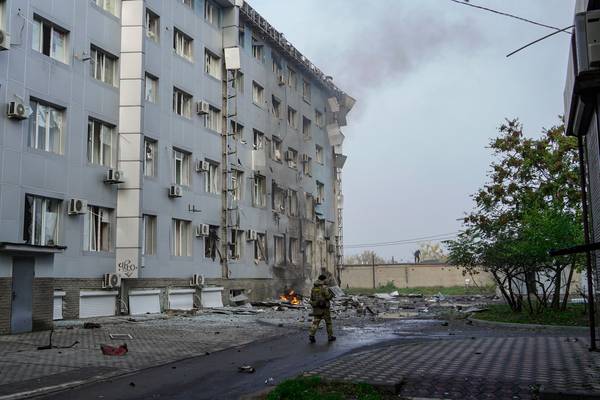
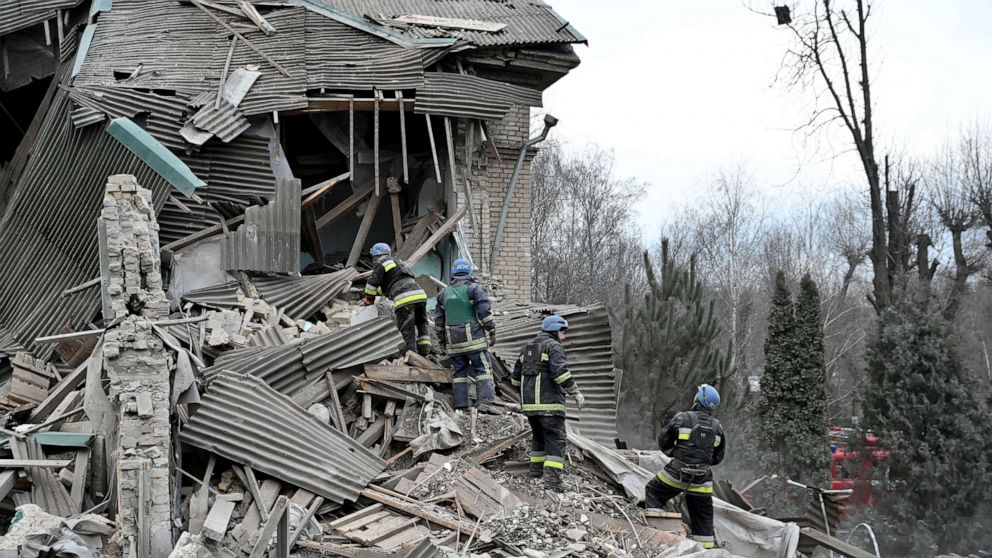
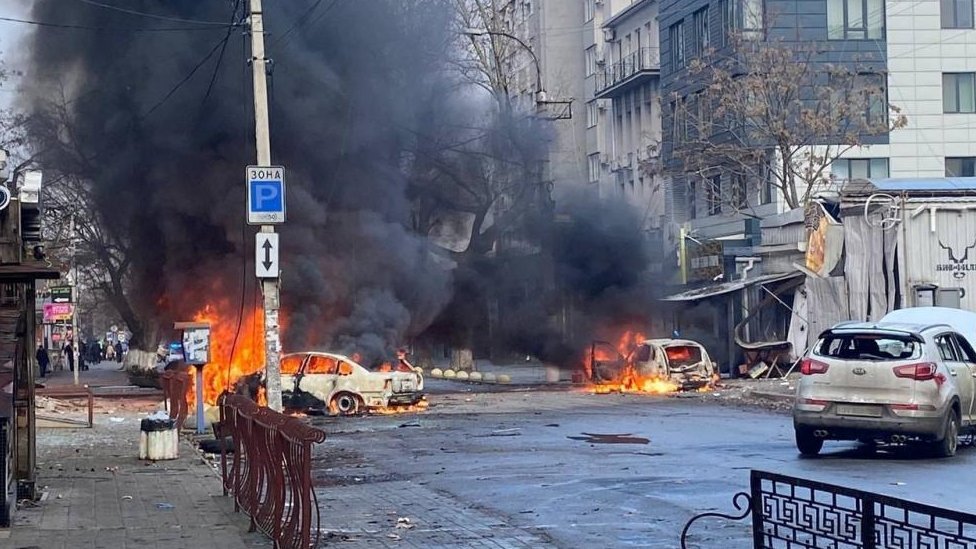
According to rescue officials, a newborn baby has been killed in a Russian missile attack on a maternity centre in southern Ukraine’s Zaporizhzhia area. A doctor and the baby’s mother, who was the only woman in the building at the time, were extricated from the wreckage.

Volodymyr Zelensky, the president of Ukraine, charged that Russia had brought “horror and bloodshed” to his nation. An important nuclear reactor is located in the Zaporizhzhia region, which has been the target of numerous Russian strikes.

The hospital’s maternity wing was hit by Russian missiles overnight, according to Ukrainian emergency services, in the town of Vilnyansk, which is still under Ukrainian control. Although Ukraine controls the territory, the entire Zaporizhzhia region has been annexed by Russia as a result of phoney referendums held in September.

Earlier on Wednesday, Kupiansk, a town in the Kharkiv region that was retaken by Ukrainian forces in September, was the target of bombardment that resulted in the deaths of two civilians, according to Ukrainian officials.

President Zelensky accused Russia of trying to “accomplish with violence and murder what it was unable to do for nine months” on the battlefield in remarks made following both attacks.

Throughout the nine-month conflict, Russia has attacked a number of hospitals, including one in Mariupol that resulted in the deaths of three people, including a toddler, in March. At the time, Russia claimed that the strike had been faked.

The World Health Organization has documented 703 attacks on health infrastructure since Russia’s invasion began on 24 February – it defines an attack as involving violence as well as threatened violence against hospitals, ambulances and medical supplies.

Russian commanders were probably use unmanned aerial vehicles (UAV) built in Iran, the UK Ministry of Defence claimed on Wednesday, to “prioritise medical facilities as targets of opportunity and hit them with guided missiles if found.”

Russia has taken control of several areas of the larger Zaporizhzhia region, including the nuclear power facility, which was seized by Russian forces weeks after the invasion started. Zaporizhzhia and other Ukrainian territory were acquired by Russia in September, although they were repelled on the battlefield in the south, particularly in the Kherson region. Across the Dnipro River, the two armies are facing one another.

Picture Courtesy: Google/images are subject to copyright

News Trending War

An upbeat activity has taken the place of visceral relief in the week after Russia withdrew from the southern city of Kherson.

Crowds of people form long lines around the city’s central square while an acoustic band plays Western covers.

Residents can obtain a hot beverage or first aid in tents. Like bees surrounding honey, a large crowd gathers near cell phone masts.

Kostiantyn tells me that “we’re peaceful now” as he stands in line to donate food while carrying his daughter on his shoulders. “No power or water is okay.”

In March, a few days after its forces invaded Ukraine, Russia seized control of the port city. Although it was the first provincial capital Russia had managed to take since February, its armed forces were compelled to leave last week.

Olena, who admitted to adjusting to the Russian occupation, was also delighted to chat. She claims that the Ukrainian forces “calm us down.”

“Now we can identify who and where is shelling. We are finally free if it is the Ukrainians who make us pleased.” We appreciate your efforts in aiding humanity. They are clearly urgently required after Russia’s eight-month blockade of Kherson.

For the estimated 75,000 residents who opted to remain in Kherson, however, much more is required for this city to recover its footing. But it is gradually reestablishing contact with Ukraine. Now, trucks rather than tanks enter the city on deteriorated roads. Additionally, train service has been restored between Kyiv and Kherson. Lorries instead of tanks now move into the city along damaged roads. Train services between Kyiv and Kherson have also resumed.

Picture Courtesy: Google/images are subject to copyright

News Trending War

Three men were convicted guilty of murder by a Dutch court for shooting down a passenger plane over eastern Ukraine in 2014, which resulted in the deaths of 298 people. The court determined that a Russian-made missile fired by an armed group controlled by Russia and supplied by Russia brought down flight MH17.

The three men—two Russians and one Ukrainian—were convicted in absentia and given life sentences. A third Russian was found not guilty. Prior to accusations of atrocities occurring there becoming a reality practically every day, the missile attack was one of the most infamous war crimes in Ukraine.

Many surviving family members of the victims believe that the invasion of Ukraine and the subsequent geopolitical upheaval could have been avoided eight years ago if the world had responded differently and taken a firmer position against Russia.

The only one of the four defendants who had a lawyer at the trial was Oleg Pulatov. Despite finding that he was aware of the missile, the judges declared him not guilty. 80 children and 15 crew members were among the 298 passengers that boarded Malaysia Airlines Flight 17 to Kuala Lumpur on July 17, 2014, at Amsterdam’s Schiphol Airport.

Over Ukraine, the aircraft was flying at 33,000 feet. It was early in Russia’s attempts to annex areas of the nation. This was a relatively low-intensity conflict area at the time, although recent air combat had increased fighting. A number of military aircraft had been shot down in the months before.

In retaliation, Ukraine shut down the airspace up to 32,000 feet below ground level. However, flights continued to span the nation. One thousand feet above this constrained airspace, the Malaysia Airlines Boeing 777 was travelling.

It lost communication with air traffic control around 13:20 GMT. 196 of the 298 passengers, who were travelling from 17 different nations, were from the Netherlands, 43 from Malaysia, 38 from Australia, and 10 from the United Kingdom. They had packed for their ideal vacations, a symposium on AIDS, family gatherings, and more. All future plans vanished in a split second.

Picture Courtesy: Google/images are subject to copyright

News Trending War

After a missile strike killed two people on a farm close to Poland’s western border with Ukraine, Andrzej Duda, the president of Poland, declared that there are no indications of an intentional attack.

US Vice President Joe Biden had earlier stated that it was “unlikely” that the missile had been launched from Russia.

The two employees perished as Ukraine came under attack from one of the war’s heaviest volleys of missile strikes.

The Kremlin had maintained that it was unrelated to their demise.

The missile that struck the farm in Przewodow, 6 kilometres (4 miles) from the border, was initially attributed to Russia, according to Poland.

Russian spokesperson Dmitry Peskov claimed Warsaw should have quickly made it obvious the debris was from Ukraine’s S-300, accusing Western nations of having an exaggerated response.

Both Russia and Ukraine employ the outdated Soviet surface-to-air missiles, and Kiev declared its desire to participate in the probe while also indicating that it was prepared to present proof of a “Russian trail” in the attack.

According to Paul Adams of the BBC, Ukraine’s air defences have been working hard to shoot down Russian missiles, and one of the missiles that was fired may have been thrown off course. The NATO ambassadors gathered in Brussels during the investigation to discuss how to respond to a member state becoming involved in Russia’s war.

No evidence, according to Secretary General Jens Stoltenberg, suggested that the incident was the product of a planned strike or that Moscow was contemplating aggressive measures against the defensive alliance.

According to Kiev, more than 90 Russian missiles were launched against Ukraine on Tuesday. Some of the missiles struck Lviv, which is close to Ukraine’s western border with Poland, despite the Ukrainian military’s claim that 77 were shot down.

The majority of the rockets fired by Russian forces, according to Ukrainian President Volodymyr Zelensky, were intended against the nation’s energy infrastructure.

The S-300 missile, which was built in Russia, was most likely to blame, but there was no proof that it had been fired by the Russian side, according to Polish President Duda, who said this at a press conference on Wednesday. Invoking Article 4 of the NATO charter, which mandates consultations in the event of a security danger, may not be required, according to Prime Minister Mateusz Morawiecki.

Picture Courtesy: Google/images are subject to copyright

News Trending War

The only regional capital that Russia managed to seize after invading in February is the Ukrainian city of Kherson, and the Russian force has been told to leave. Gen. Sergei Surovikin, the commander of Russia in Ukraine, declared that the city could no longer receive supplies. Russian forces will completely leave the western bank of the River Dnipro as a result of the withdrawal.

In light of the Ukrainian counteroffensive, it represents a severe setback to Russia. According to BBC Russia Editor Steve Rosenberg, it is embarrassing for the Kremlin as well. On Russian official television, the military’s senior brass could be seen making the choice as Gen Surovikin provided updates on the situation in Kherson.

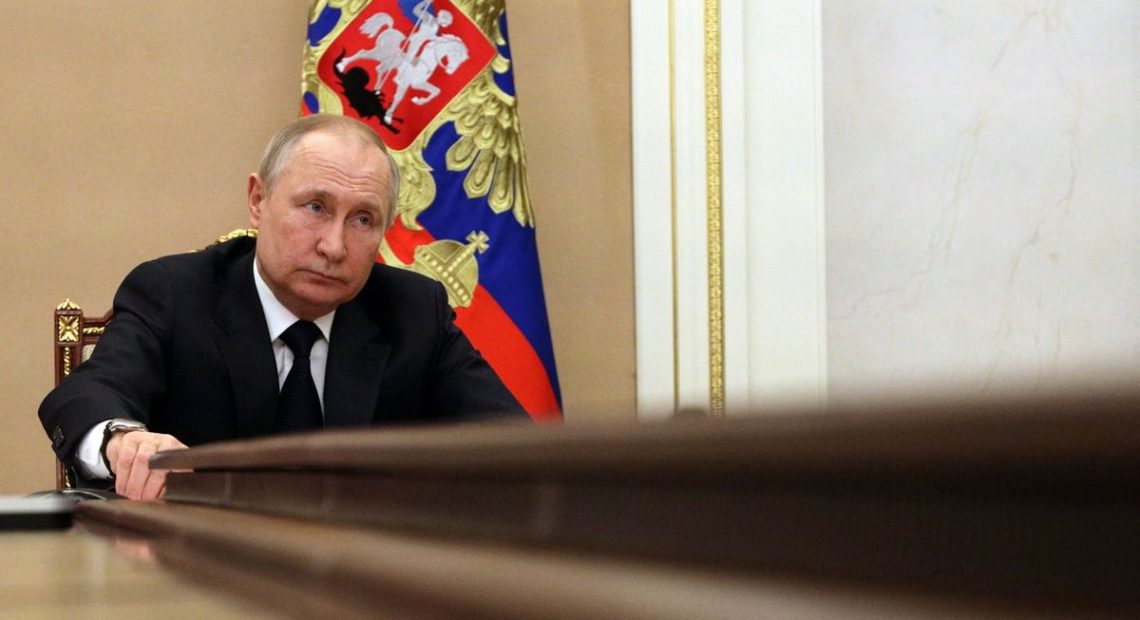
Vladimir Putin, the president, stayed away from the fake event. It seemed as though the mastermind of Russia’s futile invasion of Ukraine had delegated the declaration to his generals.

At the end of September, Mr. Putin announced that Russia had annexed Kherson as well as three other seized territories. The defence should be organised along a barrier line along the Dnipro River in these circumstances, Gen. Surovikin told the gathering.

At the beginning of the conflict, Russian forces pushed across southern Ukraine from the occupied Crimea, capturing Kherson in early March. However, Ukrainian authorities were wary of their choice to retreat over the Dnipro River. Mykhailo Podolyak, a presidential adviser, cautioned that it would be premature to take the news at its value.

Picture Courtesy: Google/images are subject to copyright

News Trending War

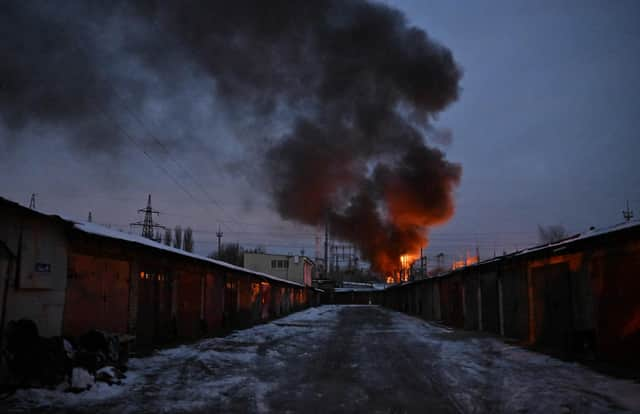
Ukraine claims that after Russia launched more than 50 missiles at critical infrastructure, the country’s power and water systems were severely damaged nationwide. According to the most recent statement from the mayor, in the Ukrainian capital Kyiv, 270,000 flats lack electricity, and 40% of people lack access to water.

The eastern city of Kharkiv also sustained damage to its energy facilities. There were thirteen injuries nationwide. Russia claimed that it had targeted Ukraine’s energy and military command networks.

All “specified objects” were struck by long-range, high-precision weapons, the nation’s defence ministry claimed. The military of Ukraine reported that 44 cruise missiles fired from the Caspian Sea and the Rostov region of Russia had been intercepted by its air defences.

Russia accused Ukraine of carrying out a drone attack on its Black Sea Fleet in the annexation of Crimea, prompting the strikes. The mayor of Kyiv, Vitaliy Klitschko, reported electricity and water shortages after the Russian attack damaged crucial infrastructure close to the city.

He initially said that 350,000 residences lacked electricity and that 80% of the city’s users lacked access to water; he later added that many people had been reconnected. Long lines were visible across the city as people waited impatiently to fill up on water from the pumps. The city authorities said that “no hits were reported” in Kyiv itself because to “the efficient operation of the air defence personnel.”

On Monday morning, reports of missile strikes were also made in Lviv in western Ukraine, Dnipropetrovsk and Zaporizhzhia in the south-east, and the central Vinnytsia region.

There are also reports of damage to a facility at the Dnipro hydroelectric power plant in the Zaporizhzhia region.

According to Prime Minister Denys Shmyhal, “hundreds of villages in seven regions” were left without electricity as a result of the damage to 18 facilities, the majority of which were energy-generating facilities, across ten different regions of Ukraine.

Picture Courtesy: Google/images are subject to copyright

News Trending

Russia has said that it will no longer take part in the international agreement, which permits Ukraine to export grain from its Black Sea ports. The accusation that Ukraine had launched a “massive” drone attack on the Black Sea Fleet in Sevastopol, Crimea, came hours earlier.

The foreign minister of Ukraine claimed that Russia was “using a false pretext.” Russia also accused British troops of taking part in the attack on Saturday and the blowing up of gas pipelines last month without offering any supporting evidence. The UK Ministry of Defence (MoD) responded by claiming that Russia was “peddling false accusations of an epic scale.”

Drones deployed in the attack on Saturday, according to the Russian defence ministry, targeted ships involved in the grain exchange. One vessel, according to the report, experienced minimal damage.

The Russian side is unable to guarantee the safety of civilian dry cargo ships taking part in the “Black Sea Initiative” and suspends its execution as of today for an extended period, according to a statement released by the Russian foreign ministry hours later.

The move, according to the statement, was “related to operations by the Ukrainian military forces, which were led by British specialists,” and these actions “were intended… against Russian ships that ensured the running of the abovementioned humanitarian corridor.”

However, Dmytro Kuleba, the foreign minister of Ukraine, claimed that Russia was obstructing the grain corridor under “a bogus pretext.” He claimed that Ukraine had “warned of Russian’s attempts to destroy” the agreement. The UN, which mediated the agreement with Turkey, was in contact with Moscow, according to a UN spokeswoman.

It went on to say that it was “essential that all parties refrain from any action that would threaten the Black Sea Grain Initiative,” which it described as a crucial humanitarian initiative aimed at enhancing access to food for millions of people worldwide.

The accord made it possible for Ukraine to resume grain exports to the Black Sea, which had been halted after Russia invaded the nation.

The UN secretary general personally negotiated it, and it was hailed as a significant diplomatic triumph that lessened a severe world food crisis.

But Russia has protested that the arrangement may not be renewed because its own exports are still being hampered.

Picture Courtesy: Google/images are subject to copyright

News Trending War

After Anton Krasovsky called for the burning and drowning of Ukrainian children, the Russian state channel RT suspended and denounced him. He has since apologised after his comments on television sparked outrage on social media.

Krasovsky was addressing science fiction author Sergei Lukyanenko, who claimed that in 1980, he had overheard children in western Ukraine saying, “Ukraine is invaded by Muscovites.” RT News has a strong pro-Kremlin stance.

Just drown those kids, Krasovsky said in the interview while grinning. He added that they could also be burned after being forced into shelters.

He also made light of the rape of Ukrainian grandparents by Russian soldiers.

Margarita Simonyan, editor-in-chief of RT, referred to Krasovsky’s remarks as “wild and disgusting.”

The station has been charged with encouraging a genocide by Ukraine. Pundits and presenters who vehemently support the conflict against Ukraine and push for additional military aggression have received a lot of airtime on Russian state television. They frequently reject proof of Russian atrocities by asserting that it is “fabricated” Ukrainian evidence, following the Kremlin’s stance.

The investigation into Krasovsky’s remarks is currently being conducted by Russia’s Investigative Committee, which deals with major offences; however, it is not yet known which laws, if any, he may have broken.

“Well, it happens: you’re on air, you get carried away, and you can’t stop,” Krasovsky said in his Monday apology. “I’m terribly humiliated,” he remarked.

When he advocated LGBT rights and denounced Russia’s statute prohibiting gay awareness campaigns that target kids, Krasovsky rose to fame on a global scale. Supporters of the measure assert that it is a response to “homosexual propaganda.”

Krasovsky has been in charge of RT’s Russian-language programming for the previous two years. Because of his ardent support for President Vladimir Putin’s invasion of Ukraine, he is subject to EU sanctions.

Mikhail Khodorkovsky, a well-known anti-Kremlin activist in London, voiced contempt for RT’s position. As he tweeted: “Margarita Simonyan refuses to work with Anton Krasovsky, who advocates for the murder of Ukrainian children. Margarita Simonyan, however, is unwilling to work with Putin since he murders Ukrainian children “.

Picture Courtesy: Google/images are subject to copyright

News Trending War

Russia has launched a series of attacks against Ukraine, using what appear to be “kamikaze” drones produced in Iran to dive-bomb the city of Kyiv.  The administration claims that hundreds of towns and villages in the Kyiv, Dnipro, and Sumy regions had their energy shut off.

At least eight individuals were slain, including four each in Sumy and Kyiv. As Iran continues to deny providing drones to the Russian military, calls for sanctions against the country have grown.

Russian missiles struck the Ukrainian capital a week ago during rush hour as part of widespread attacks that claimed 19 lives. 28 drones targeted the capital in the most recent attack, which began at around 6:00 (03:30 GMT), but only five of them struck their intended targets, according to Vitaliy Klitschko, the mayor.

Gunfire rattled around the city as anti-aircraft batteries urgently attempted to shoot them down. One interception looked to be captured on video posted on social media.

Rescuers in the Shevchenkivskyi neighbourhood looked for survivors among the rubble of an apartment building that partially collapsed during one attack. As numerous firefighters and emergency personnel worked at the site, the street was blocked off. A pregnant woman was one of the four individuals slain in the area.

The offices of Ukraine’s energy business were also damaged; they were located across the street from the demolished structure. It’s likely that the facility was the strike’s intended target. The attacks were referred to as a “genocide of the Ukrainian people” by Mayor Klitschko, who added that “The Russians demand a Ukraine without Ukrainians.”

Picture Courtesy: Google/images are subject to copyright

News Trending

The Nobel Peace Prize has been given to a jailed activist from Belarus as well as two organisations from Russia and Ukraine for promoting democracy and human rights. As a rebuke to two authoritarian governments, the choice to honour Ales Bialiatsky, Russia’s Memorial, and the Ukrainian Center for Civil Liberties.

In December of last year, Russia forcibly closed Memorial in advance of Vladimir Putin’s decision to invade Ukraine. Alexander Lukashenko protests led to the imprisonment of Bialiatsky. The CCL of Ukraine has kept tabs on political repression and atrocities committed in regions of the nation that Russia has invaded or annexed.

All three had made “an excellent effort to expose war crimes, human rights abuses, and the misuse of power,” according to Berit Reiss-Andersen, head of the Norwegian Nobel Committee, who spoke to reporters.

She responded that the Nobel prize was always given “for something and to somebody and not against anyone” when asked if the committee was making a statement to Russia’s president on the occasion of his 70th birthday.

Belarus’s long-time ruler is a close ally of President Putin. After a re-election in 2020 that was widely condemned as rigged, he brutally cracked down on protesters and then allowed Russian forces to use his country as a launchpad in its war against Ukraine.

Ales Bialiatsky, 60, established the civil rights organisation Viasna, which is Belarusian for spring, in 1996, two years after Mr. Lukashenko took office. He was first imprisoned in 2011, and last year, he was again incarcerated without being given a reason. He is one of the 1,348 individuals that Viasna claims are being imprisoned as political prisoners in Belarus at the moment.

Svetlana Tikhanovskaya, an exiled opposition activist, hailed the Nobel committee for “recognising all Belarusians struggling for freedom and democracy,” and Natallia Pinchuk, Bialiatsky’s wife, said she was “overwhelmed with emotion.”

A spokesman for the Minsk foreign ministry claimed that Alfred Nobel was “turning in his grave” as a result of the awarding of the Nobel Peace Prize to Bialiatsky.

Picture Courtesy: Google/images are subject to copyright