News Trending

Officials from Poland and Germany are attempting to determine what is causing a large-scale fish die-off in the Oder river, which divides the two nations. Since late last month, hundreds of kilometres of the river have been covered in thousands of dead fish.

Although tests have been conducted, it is believed that a harmful substance entered the water. However, the precise chemical is yet unclear. The German government has issued warnings about an impending environmental catastrophe and has advised people to stay away from the river.

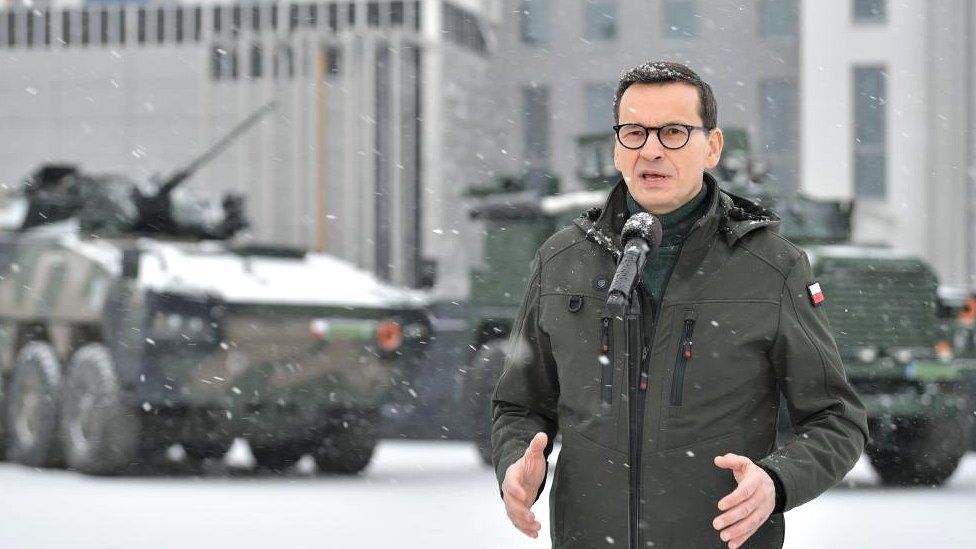
However, activists have accused the government of both nations of neglecting to cooperate in order to promptly respond to the tragedy and protect people. Mateusz Morawiecki, the prime minister of Poland, fired two environmental officials on Friday for how they handled the situation.

German Environment Minister Steffi Lemke demanded a thorough inquiry into the incident and stated that investigators were working “full out” to determine its cause. Following the first complaints of a problem from Polish fishermen and anglers as early as July 28, tonnes of dead fish are alleged to have been pulled from the river.

According to the news agency AFP, the Oder is a river that is typically regarded as clean and serves as a habitat for 40 domestic fish species. However, a representative of the Brandenburg state in eastern Germany claimed test findings indicated elevated oxygen levels in the water, suggesting the presence of an alien material.

According to Katarzyna Kojzar, a journalist for the Polish investigative website OKO.press, beavers, birds, and ducks have also been impacted.

However, a heatwave and record low water levels on the Oder meant that fish were already in trouble, according to Christian Wolter of the Leibniz Institute.

Picture Courtesy: Google/images are subject to copyright

News Trending

Twelve people were killed on Saturday in Croatia when a bus transporting Polish pilgrims ran off the road and into a ditch. According to reports, all 32 still alive passengers had injuries, 19 of them badly. Three priests and six nuns were part of the journey, which was planned by the Catholic organisation Brotherhood of St. Joseph. They were going to the Bosnian Catholic site of Medjugorje.

The Polish Foreign Ministry reported that all of the passengers were adults from Poland.

When the bus they were riding in drove off the A4 road between Jarek Bisaski and Podvorec, northeast of Zagreb, the accident occurred at about 05:40 local time (04:50 GMT).

Two Polish ministers are travelling to Croatia in response to the catastrophe, and Poland’s justice minister and prosecutor general have directed the Warsaw Prosecutors Office to begin an investigation into the circumstances leading up to the disaster.

Although 11 deaths were first reported, one more passed away later in a hospital.

They were all pilgrims, mostly from the Masovian province’s Radom and Sokolow, which also contains Warsaw, the capital of Poland.

The driver was not believed to be one among the dead, according to the Polish Foreign Ministry, but this has not yet been verified. Andrej Plenkovi, the prime minister of Croatia, sent his sympathies to the relatives of the victims and said in a tweet that the emergency services were doing everything they could to assist. Poland is a very famous destination for pilgrims because of rumours that in the 1980s, local youngsters witnessed an apparition of the Virgin Mary there.

Picture Courtesy: Google/images are subject to copyright

News Trending War

Poland is holding its breath as Russia’s war in Ukraine rages on its doorstep. It is vulnerable on two fronts: the number of refugees entering the country is increasing, and a military base near its Ukrainian border has been attacked.

According to the latest UN figures, over 1.7 million Ukrainians have chosen to flee to Poland as a first responder in one of Europe’s largest refugee crises since World War Two. Some leave, but the majority choose to remain due to cultural, linguistic, or familial ties. As a result, the population of Warsaw, Poland’s capital, has increased by 15% in the last two weeks.

Alarm bells are also ringing in terms of security. Russia bombed a Ukrainian military base in Yavoriv, just 16 kilometres (10 miles) from the Polish border, over the weekend.

For years, Poland has warned the West that Russia was planning to redress the power balance in Europe in its favour. At the time, Polish leaders were dismissed as alarmists. But that is no longer the case. Mateusz Morawiecki, the Polish Prime Minister, said on Monday that Ukrainian soldiers needed and deserved Western assistance. He insisted that they were fighting not only for their own liberties, but also for the liberties of their Eastern European neighbours. He also described Russian President Vladimir Putin’s aggression in Ukraine as part of a calculated geopolitical strategy.

The Western defence alliance’s charter says an attack against one of its nations will be viewed as an attack against all. That would mean a face-off between two global nuclear powers – Russia and the US – something the West is keen to avoid. Moscow too, it hopes.

Rafal Trzaskowski, the mayor of Warsaw and a high-profile political figure, told me that his country was not panicking, but that people were beginning to ask questions, particularly in light of Russia’s missile strike so close to the Polish border and Nato’s suggestion that Russia was planning chemical attacks. The mayor insisted that something urgent be done about the refugee crisis as well.

Mayor Trzaskowski has also urged the UK to “get rid of its red tape” and make it easier for Ukrainian refugees to enter the country.

Poland’s painful past, it could be argued, makes it fearful of the future. The arrival of Ukrainian refugees in this country has brought back memories of war and Soviet occupation. I met Kristina, a Polish pensioner, and her friends in Warsaw this week, who were busy making Ukrainian flag solidarity ribbons. “Kristina explained, “I’m too poor to give money and too old to hold a gun, so I do what I can for the refugees.” Partly because I am concerned about my own future.”

Picture Courtesy: Google/Images are subject to copyright

News Trending

In a dispute over judicial reforms, the EU’s top court has ordered Poland to pay a daily fine of €1 million (£850,000). Poland was forced to suspend a contentious disciplinary chamber earlier this year but has failed to do so.

It’s the latest twist in a tumultuous relationship with the EU over moves perceived as undermining the independence of Polish courts. Polish government spokesman Piotr Muller quickly decried the harsh penalty as “blackmail.” Some fear that the worsening tension would jeopardise Poland’s EU membership.

When there is a dispute between Polish and EU law, Poland’s constitutional court declared earlier this month that Polish law takes precedence over EU law, angering European leaders by effectively rejecting the primacy of EU law.

Pic Courtesy: google/ images are subject to copyright

News Trending

Two conservative European countries, Hungary and Poland, have blocked the Covid-19 recovery fund, introduced to help those countries which were destroyed by the virus outbreak.

The European Union budget has been stopped using a clause that ties funding with adherence to the rule of law in the bloc.

Had the budget been passed, those countries which were devastated by the virus outbreak would have received a strong financial support of €750bn.

The EU functions on the basis of consensus. Each and every member has the right to veto European Union Budget.

The EU consists of over 27 member countries.

Hungary and Poland have used their veto power to block the budget.

Actually, these two conservative countries are not in a good relation with the rest of the European Union countries.

 The EU is currently investigating both countries for undermining the independence of courts, media and non-governmental organisations.

EU states had already agreed on the €1.1tn budget for 2021-2027, and the coronavirus stimulus package after a marathon four-day summit in July.

It is yet to been seen how the EU will handle the present crisis.

The EU is at the edge of a possible collapse. Already, the Covid-19 affected countries are angry with the EU for not coming to its rescue in a timely manner.

Photo Courtesy: Google/ images are subject to copyright 

News

The Polish government has exerted force against people protesting against a court ruling that bans abortions in the country.

The protest has been witnessed in several regions across the country, including in the Polish capital, Warsaw.

It has been organised outside the official residence of the Polish Deputy Prime Minister, Jaroslaw Kaczynski.

As per the court order, ending the life of a deformed foetus is unconstitutional. According to the order, abortion is only valid in cases of rape or incest, or to protect the mother’s life.

Poland is the country where one of the toughest abortion frameworks exists. The new order is expected to make the framework tougher.

The protest against abortion has taken place not only in Poland, but also across the continent of Europe.

This is not the first time that the country has witnessed a protest in connection with the matter.

The new court order has the backing of the ruling party, as its attempt towards this extent was earlier foiled by a similar protest.

Photo Courtesy: Google/ images are subject to copyright 

News Trending

The European country of Poland, which is a conservative country, is set bring in a total ban on abortion.

The abortion law in Poland is one of the strictest in the continent of Europe.

The new move means the country will witness a tough protest on this matter in the near future itself.

 At present, Poland only allows abortion in cases of rape or incest, if the mother’s life is at risk, or if the featus is seriously compromised.

The new legislation intents to limit the provisions to cases of foetal defects.

Several human rights organisations have raised their voice against the move. They have appealed for the intervention of the progressive world against the move.

They have also urged the political community to reject the move to dilute the abortion law in the country of Poland.

It was a mass protest that dismissed a similar attempt to dilute the abortion law. Then also, that was attempted by the ruling.

This time also, the move is backed by the ruling party.

Photo Courtesy: Google/ images are subject to copyright 

News

A tough ban on protest has failed to prevent protesters from taking to streets in the European country of Belarus.

Over tens of thousands of people have taken part in a protest organised to express their disagreement towards the election – which has reaffirmed the president’s claim for the seat.

Protesters allege that the election was not done in a free and fair manner. They demand the resignation of the President – who has been sitting in the seat of power of the ex-Soviet satellite since the year 1994.

Meanwhile, the President – who has reaffirmed his claim for the seat through the election – has vowed to suppress the protest. He has dismissed the protest as the one born with the blessings of foreign forces.

Belarus is a very powerful European power. It is at present, in a way, a satellite country of Russia. It, thus, does not have a good relation with its neighbours who consider Russia as a threat to their sovereignty.

Recently, Amnesty International revealed that those who were arrested in connection with the protest in Belarus were brutally tortured in prisons. As per a report, some protesters were even threated with rape.

Photo Courtesy: Google/ images are subject to copyright 

News

As many as three people have been booked in Poland on charges of desecrating monuments and offending religious feelings.

As per the case, the arrested persons hanged flags symbolizing LGBT on some statues situated in the country.

The flags were hanged on statues of Copernicus and several other persons Pols consider as sacred or respectable. Even some statues were dressed in pink face masks.

Those carried out the act has links to the LGBT movement launched against the anti-LGBT policies of the present Poland government.

The Polish government has strongly criticized the action. Some senior political leaders have come out strongly against the move.

Prime Minister Mateusz Morawiecki has denounced those who have been booked in connection with the crime.

He has reminded the country that the statues symbolised values.

The incident clearly explains why it is necessary to take a right path if the end result expected is positive.  

Photo Courtesy: Google/ images are subject to copyright 

News

Andrzej Duda, the incumbent President of the European country of Poland, has won the Presidential Election, defeating his nearest rival, Rafal Trzaskowski, with a narrow majority.

The President has wristed around 51.2 per cent of the total number of votes casted in the Presidential Election.

It is the toughest competition the country has witnessed since the collapse of the communist rule in the early 1990s.

The victory of Mr. Duda has many political implications. It has strengthened the position of the conservative faction.

The person whom the incumbent President has defeated in the Presidential Election, is a member of the liberal faction.

The victory of the conservative leader may reflect in the future of the relation between the European country of Poland and the most powerful economic union of the European Union.

The narrowness of the victory margin proves that the political clout of the liberal faction is increasing in the country and may topple the dominance of the conservative faction any moment.

Mr. Duda’s retention of the seat of President is a great relief to the conservative parliamentarians.   

Photo Courtesy: Google/ images are subject to copyright