featured News Trending

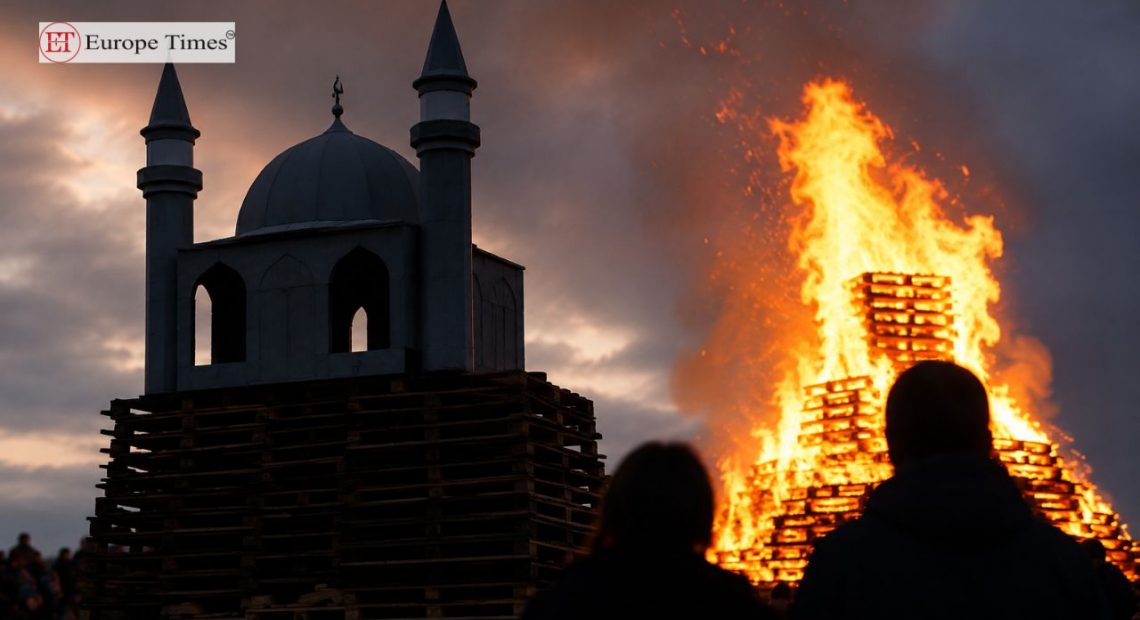
A replica of a mosque placed atop a traditional loyalist bonfire in Moygashel, Northern Ireland, was set alight a day earlier than planned, preventing police from removing what they described as a “hate display.” The structure, erected ahead of the annual July 12 commemorations of the 1690 Battle of the Boyne, drew widespread condemnation from political leaders and law enforcement.

Police said they had intended to remove the display as evidence before it was burned, calling it a potential hate crime. A 56-year-old man has been charged with incitement to hatred and is scheduled to appear in court. UK Northern Ireland Secretary Hilary Benn condemned the display as a “sickening and cowardly act of intimidation.”

The incident comes amid heightened tensions following recent anti-migrant violence in Belfast. Organisers had also displayed banners carrying anti-immigration and anti-Islam messages, while the replica included an effigy holding what appeared to be a knife. Similar controversial displays have appeared at the same bonfire site in previous years, reflecting growing concerns over hate-fuelled symbolism during the annual celebrations.

Pic courtesy: google/ images are subject to copyright

featured News Trending

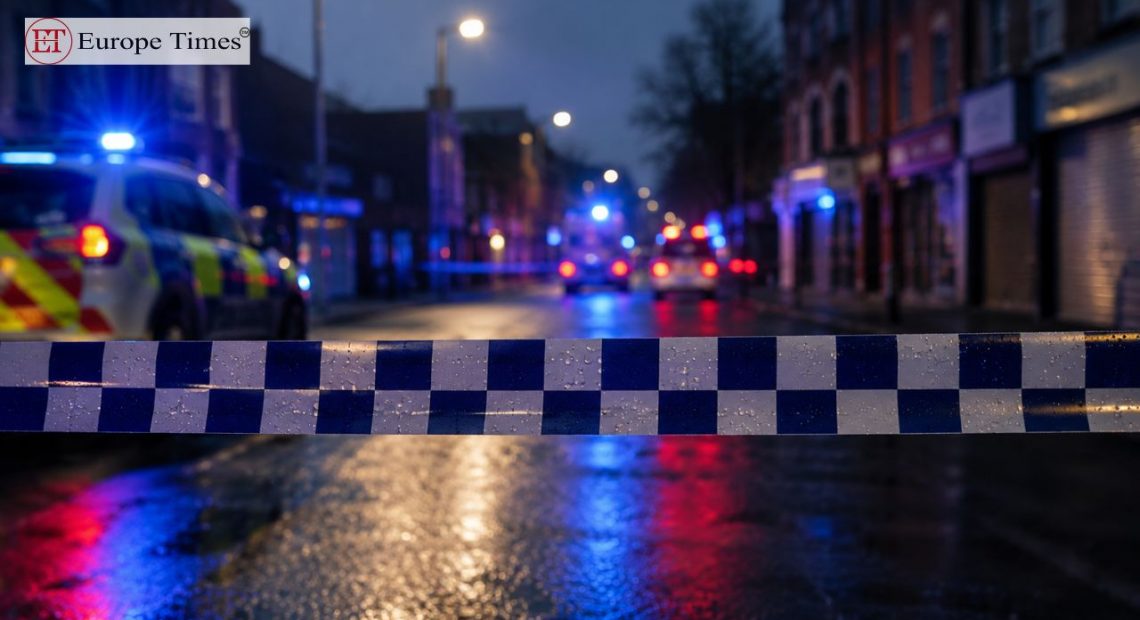
Police in Northern Ireland have arrested a man in his 30s, believed to be from Somalia, following a knife attack in north Belfast that left a man in his 40s seriously injured. The incident, which occurred on Monday evening, gained widespread attention after footage of the attack circulated on social media.

Authorities have declared the case a critical incident and launched an investigation to determine the motive behind the assault. Police have urged the public not to share videos of the attack, warning that doing so could cause further distress to the victim’s family and potentially affect the ongoing investigation.

The incident has prompted calls for protests online, leading political leaders to appeal for calm. UK Prime Minister Keir Starmer described the attack as “sickening,” while Northern Ireland Deputy First Minister Emma Little-Pengelly condemned it as a “savage and barbaric” act and expressed support for the victim and his family.

Pic courtesy: google/ images are subject to copyright

Entertainment News Trending

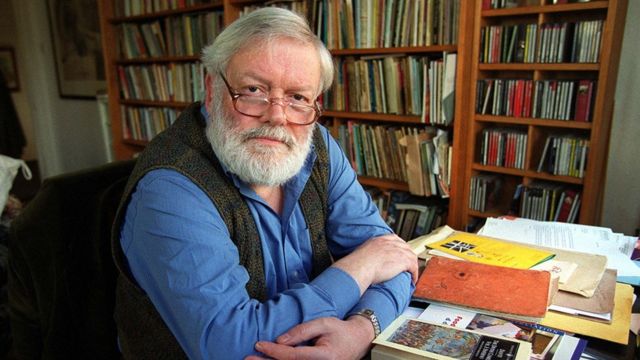
Michael Longley, a poet from Belfast, has received a €250,000 (£216,000) European cultural award. At a ceremony in November, Longley will accept the Feltrinelli International Prize for Poetry. Former winners of the award include John Ashbery, Eugenio Montale, and WH Auden.

Longley was born in 1939, and at the age of 30, he released No Continuing City, his debut book of poetry. From 2007 to 2010, he served as Ireland’s professor of poetry. Italy’s Accademia Nazionale dei Lincei bestows the prize once every five years in each discipline, on a national and international level.

According to the Accademia dei Lincei, Mr. Longley won because of “the extraordinarily relevant nature of his ideas and the cultural ramifications they have, as well as the very high level of stylistic excellence of his work.”

It read: “Longley is a tragic singer of Ireland and its dramatic past and an amazing poet of landscape, especially of the Irish West, which he examines with the careful and passionate attention of an ecology.

But he has also addressed subjects such as loss, grief, and sympathy in his poetry, as well as the seduction, conquest, and enchantment of love, the shock of war in all times, the tragedy of the Holocaust, and the gulags.

The Belfast native’s parents, both Londoners who emigrated to Northern Ireland prior to the birth of their son, were both World War One veterans from England.

He and his twin brother were born on July 27, 1939, in Lower Crescent, a neighbourhood off University Road in Belfast, only weeks before World War Two broke out.

Both the Royal Belfast Academical Institution (also known as Inst) and Trinity College in Dublin, where Longley later studied classics, had an impact on his career.

When he “fell in love very strongly” with a girl from a local school, Methodist College, he began his writing career in his early teens.

He was given the Queen’s Gold Medal for Poetry in 2001, as well as the Wilfred Owen Award in 2003. In 2010, he was appointed CBE.

For his contributions to literary and cultural life in Belfast, where he and his wife, the critic Edna Longley, reside and work, he was given the freedom of the city in 2015.

Picture Courtesy: Google/images are subject to copyright