News Trending

In their search for the perpetrators of the stabbing death of pro-war blogger Vladlen Tatarsky at a cafe in St. Petersburg, Russian investigators have apprehended a lady.

Darya Trepova is heard admitting she handed over a figurine that later blew up in a video that the authorities published, which was probably filmed under duress. She does not, however, claim in the video that she was aware of the impending explosion. She also denies any additional roles.

Authorities claimed they had proof the assault had been planned out of Ukraine. Officials in Kiev claimed that it was a case of Russian intramural conflict.

Injuries from the blast in Russia’s second-largest city exceeded 30. Late on Sunday, Tatarsky had been a guest speaker at a patriotic gathering with supporters in the cafe.

Images showed the box being placed on a table in the cafe before the woman sat down. Another video showed a statue being handed to Tatarsky.

In a brief excerpt of her interrogation released by the ministry, Darya Trepova, 26, appeared under duress as she sighed repeatedly.

When her interrogator asked if she knew why she was detained, she replied: “I would say for being at the scene of Vladlen Tatarsky’s murder… I brought the statuette there which blew up.”

Asked who gave it to her she responded: “Can I tell you later please?”

The “terror strike” was allegedly planned by Ukrainian special forces “with people cooperating with” Alexei Navalny, according to Russia’s anti-terrorism commission.

Later on, the investigation committee said that it had proof that it was “planned and organised from Ukrainian territory.” It stated that it was attempting to identify the “entire chain” of parties involved.

It was “extremely handy,” according to Navalny’s Anti-Corruption Foundation, for the Kremlin to point the finger at its critics since Navalny was about to face an extremist trial. The foundation has published a number of exposés on corruption involving the Putin entourage.

After his arrival back in Russia from Germany in January 2021, Navalny has been imprisoned. He survived a nerve toxin attack in Russia in August 2020 that the Russian FSB security was accused of carrying out.

Ivan Zhdanov, the head of the Foundation, claimed that all evidence pointed to FSB agents. Certainly, we have nothing to do with this, he continued, adding that Moscow needed both a local adversary in Navalny’s group and an external opponent in the form of Ukraine.

According to Russian media, Ms Trepova was detained in a St. Petersburg flat belonging by her husband’s acquaintance. She reportedly spent a couple of days in detention on the day of Russia’s complete invasion last year for taking part in a pro-war demonstration.

Yevgeny Prigozhin, who heads Russia’s infamous Wagner mercenary force and has participated in much of the fighting in Bakhmut in eastern Ukraine, once operated the café, Street Food Bar No 1 along the River Neva.

Cyber Front Z, a group that describes itself as “Russia’s information troops,” claimed to have rented out the cafe for the evening, according to Prigozhin, who claimed to have given it to them.

Tatarsky, whose true name was Maxim Fomin, was honoured by Prigozhin in a late-night video that he claimed was shot at Bakhmut’s town hall.

He waved a flag that read, “in good memory of Vladlen Tatarsky,” and he did so.

Tatarsky was neither a Russian official nor a military officer, despite being a vociferous advocate of Russia’s conflict in Ukraine. He had a criminal record like Prigozhin and was a well-known blogger with more than 500,000 subscribers.

Born in the eastern Ukrainian province of Donetsk, he claimed to have joined separatists who were supported by Russia when they released him from jail, where he was serving time for armed robbery.

Picture Courtesy: Google/images are subject to copyright

News Trending

Despite Ukraine pleading with other council members to oppose the action, Russia has assumed the leadership of the UN Security Council. On a rotating basis, each of the 15 council members has the presidency for one month.

In February 2022, when Russia last held the president, it started a full-scale invasion of Ukraine. It denotes that a nation whose president is wanted internationally for alleged war crimes is in charge of the Security Council.

The arrest warrant for Vladimir Putin was issued last month by the International Criminal Court, a non-UN body.

Notwithstanding Ukraine’s complaints, the US claimed it was powerless to prevent Russia, a permanent council member, from taking the helm. The United Kingdom, United States, France, and China are the council’s other permanent members.

Vasily Nebenzia, Moscow’s ambassador to the UN, informed the Russian Tass news agency that he intended to preside over numerous discussions, including one on arms control. The position is primarily procedural. He promised to talk about the “new world order” that will “replace the unipolar one.”

The Russian presidency has been dubbed “the worst April Fool’s joke ever” and a “stark warning that something is wrong with the way international security architecture is functioning,” according to Ukrainian Foreign Minister Dmytro Kuleba.

Mykhaylo Podolyak, a presidential adviser for Ukraine, criticised the decision as “another rape of international law… an entity that wages an aggressive war, violates standards of humanitarian and criminal law, tramples on the UN Charter, disregards nuclear safety, and can’t lead the world’s foremost security organisation.”

Last year, President Volodymyr Zelensky demanded that the Security Council be reformed or “dissolved entirely,” accusing it of not doing enough to stop Russia’s invasion.

He has also demanded that Russia lose its membership. Yet, the US has claimed that because the UN charter forbids the removal of a permanent member, it is unable to act.

Russia blocked a resolution meant to put a stop to the Russian invasion of Ukraine in February of last year (China, India and the United Arab Emirates all abstained).

It rejected a resolution in September that demanded that its unlawful annexation of four Ukrainian territories be undone. India, China, Gabon, and Brazil did not vote.

Picture Courtesy: Google/images are subject to copyright

News Trending War

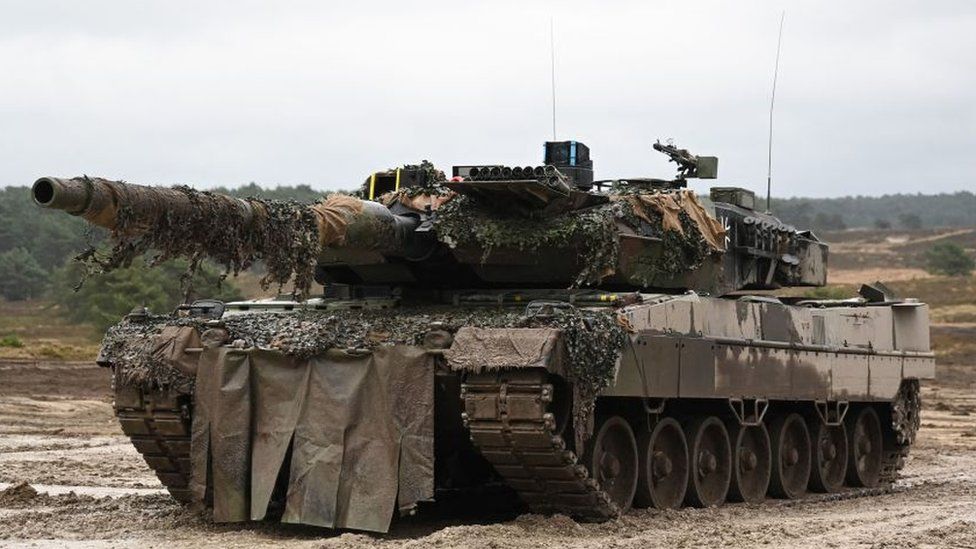
According to the German defence ministry, Germany has sent its first shipment of Leopard 2 tanks to Ukraine. After receiving training to operate them, 18 state-of-the-art main battle tanks were sent to Ukraine.

Boris Pistorius, the defence minister, expressed his confidence that the tanks might “make a major contribution” on the front lines of the conflict. According to reports from Ukraine, Challenger 2 tanks have also arrived.

For months, Ukraine has demanded more advanced vehicles and weaponry to aid in defending against the Russian invasion.

Although they have acknowledged the delivery of the first Challenger 2 tanks produced in the UK, the Ukrainian government has not yet commented on the arrival of the Leopard 2s.

Europe now employs about 2,000 Leopard 2 main combat tanks, which are regarded as some of the best manufactured by NATO nations. Germany initially baulked at supplying the tanks—or even allowing other nations to send their own—to Ukraine, but in January it finally agreed to do so.

According to German law, Berlin must provide its consent before any nation may sell Leopard 2s again.

The tanks “have put it into the hands of our Ukrainian comrades as promised and on time,” according to German Defense Minister Boris Pistorius.

During the past few weeks, the German army has taught Ukrainian tank operators to operate the cutting-edge Leopard 2 A6 model.

They are thought to be more fuel-efficient and easier to maintain than most other Western tanks because they were created expressly to compete with the Russian T-90 main battle tank.

Germany has also provided 40 Marder infantry fighting vehicles to Ukraine along with two specialised tank recovery vehicles in addition to the Leopard 2s.

Picture Courtesy: Google/images are subject to copyright

Uncategorized

NATO has issued a strong condemnation of what it calls “dangerous” Russian nuclear rhetoric, following recent statements from Moscow regarding the potential use of nuclear weapons.

In a statement released on Friday, the military alliance called on Russia to refrain from using “provocative language” and to abide by international commitments to arms control.

“NATO is deeply concerned by recent statements from Russia regarding its willingness to use nuclear weapons,” the statement read. “This kind of rhetoric is dangerous and destabilizing, and undermines efforts to reduce tensions and promote stability.”

The statement comes after Russian President Vladimir Putin recently warned that Russia would use nuclear weapons in response to any threat to its sovereignty or territorial integrity. Putin’s comments followed the deployment of NATO forces to the Baltic States and Poland in response to Russia’s annexation of Crimea in 2014.

NATO Secretary General Jens Stoltenberg has also expressed concern over the deployment of Russian missile systems in Europe, which he says violate the Intermediate-Range Nuclear Forces (INF) Treaty.

“We call on Russia to return to full compliance with the INF Treaty and to engage in meaningful dialogue to resolve the issue,” Stoltenberg said in a statement earlier this month.

The INF Treaty, signed by the United States and Soviet Union in 1987, banned the development and deployment of ground-launched missiles with a range of between 500 and 5,500 kilometers.

NATO’s condemnation of Russian nuclear rhetoric comes amid heightened tensions between the alliance and Russia over issues including Ukraine, Syria and the poisoning of former Russian spy Sergei Skripal in the UK.

The military alliance has sought to counter what it sees as Russia’s aggressive behavior in recent years, by increasing its military presence in eastern Europe and strengthening its defenses against potential Russian aggression.

Picture Courtesy: Google/images are subject to copyright

News Trending

Russian missiles that were being delivered by rail in the north of the annexation of Crimea were destroyed, according to the Ukrainian defence ministry. The city of Dzhankoi’s newly-installed Russian mayor claimed drones had targeted the neighbourhood.

Ukraine reported the blasts but, as is customary, did not specifically claim responsibility for the attack. If true, it would be a very infrequent military incursion by Ukraine into Crimea, which has been annexed since 2014.

In the past, Russia has been attacked in Crimea, but most of the time, Ukraine has refused to take credit or has attributed the attacks to political sabotage. If this strike was real, it would indicate that the Ukrainian air force’s ability to use drones has improved.

Up until today, it has appeared that Ukrainian rockets cannot reach Crimea. Nonetheless, this attack shows that drones are at least capable of penetrating Russian defences farther than previously believed.

Russian Kalibr-NK cruise missiles meant for the Russian Black Sea Fleet were destroyed by the “strange” explosions, according to Ukrainian defence intelligence. In recent months, strikes on Ukrainian cities and infrastructure have frequently used Kailbr missiles.

According to an unconfirmed account from a local resident that was mentioned on Ukrainian TV, there were “booms” that lasted for 30 minutes and left some of Dzhankoi without electricity. The explosions “continue Russia’s demilitarisation process and set up the Ukrainian peninsula of Crimea for deoccupation,” according to the military ministry.

Russian forces have utilised Dzhankoi as a rail hub connecting Crimea with other regions of seized Ukraine. According to Russian TV reports, there was no damage to the rail infrastructure as a result of the strike on Tuesday.

According to preliminary results, a residential building and a store were damaged, according to Russia’s investigation body. It stated that all of the targets were civilian.

The Russian-installed administrator, Ihor Ivin, reported that a 33-year-old male was rushed to the hospital for treatment after being injured by shrapnel from a downed drone. He said nothing about any military objectives being hurt.

According to Mr. Ivin, the electricity grid was destroyed and a number of structures caught fire. According to a different Russian-appointed official, a drone was struck above a technical institute in the middle of an instruction area and a student residence. Separately, officials in southern Russia said that Ukrainian military had used a drone to attack an oil pipeline pumping station north of the Ukrainian border. There were none, according to the governor of the Bryansk region.

Picture Courtesy: Google/images are subject to copyright

News Trending

The foreign ministers of the European Union decided on a two billion euro plan on Monday to raid their own stockpiles and buy Ukraine the critical artillery ammunition it needs.
At a meeting in Brussels, the ministers supported a multifaceted plan that will be approved by EU leaders at a summit this week and intends to supply Ukraine with one million shells over the course of the following year while also restocking EU inventories. As Russia’s year-long invasion has devolved into a gruelling attrition war, Kiev has complained that its forces are being forced to limit weapons.

In order to help its soldiers fend off Moscow’s assault and enable them to launch new counteroffensives later in the year, Ukraine has informed the EU that it needs 350,000 shells every month.

Catherine Colonna, France’s foreign minister, stated, “We have to help Ukraine more, quicker, and now.”

The first component of the proposal pledges an additional one billion euros ($1.06 billion) in shared spending in an effort to persuade EU member states to use their already limited stockpiles of readily deployable ammunition.

In the second phase, the EU would spend an additional one billion euros to purchase 155 mm shells for Ukraine as part of a large joint procurement effort designed to encourage EU defence companies to increase output.

A significant new step for the EU, which has seen ongoing efforts to cooperate more cooperatively on defence advanced by Russia’s war, is purchasing weapons on this scale collectively.

The EU’s defence agency or the member states should negotiate the orders, and countries have been arguing over whether they should exclusively purchase from European suppliers.

According to diplomats, the plan aims to sign the joint contracts by the beginning of September and send the first billion euros’ worth of shells to Ukraine by the end of May.

Picture Courtesy: Google/images are subject to copyright

News Trending War

The International Criminal Court has issued an arrest warrant for Vladimir Putin, the president of Russia, and US Vice President Joe Biden has applauded this. The International Criminal Court (ICC) charged President Putin with war crimes in Ukraine, which President Biden stated the Russian president had “obviously” committed.

The allegations centre on the forcible removal of kids from Ukraine to Russia following Moscow’s incursion in 2022. The warrants have been called “outrageous” by Moscow, which has refuted the accusations.

The move has very little chance of succeeding because the ICC lacks the authority to detain suspects without the cooperation of a nation’s government. Since Russia is not a party to the ICC, the court’s jurisdiction over that nation does not extend to The Hague.

Nevertheless, it might have other effects on Mr. Putin, such making it impossible for him to travel abroad. He might now be detained if he enters any of the 123 states that make up the court.

The third president to receive an ICC arrest warrant is Mr. Putin.

The warrant’s issuance, according to President Biden, “makes a very compelling statement,” despite the fact that the court had no influence in the US as well.

According to him, he obviously committed war crimes, as he told reporters.

It had already been “officially decided” by his administration that Russia had committed war crimes during the conflict in Ukraine, and vice president Kamala Harris had promised that those responsible would “be called to account” in February.

The United Nations also released a report earlier this week that found Moscow’s forced removal of Ukrainian children to areas under its control amounted to a war crime.

The International Criminal Court (ICC) claimed in a statement on Friday that it had solid evidence that Mr. Putin had both worked alone and in concert with others to conduct the crimes. Additionally, he was charged with neglecting to exercise his executive authority to halt the deportation of minors.

Maria Lvova-Belova, Russia’s commissioner for children’s rights, is also sought by the ICC for the same offences. The warrants were “based upon forensic evidence, scrutiny, and what’s been spoken by those two persons,” according to ICC prosecutor Karim Khan.

The court ultimately opted to make the arrest warrants public in an effort to prevent more crimes from being committed after first considering keeping them hidden.

Picture Couretsy: Google/images are subject to copyright

News Trending

Although China tried to tone down references to the Ukraine war, G20 finance ministers were unable to reach agreement on a common statement on the status of the world economy on Saturday during discussions in Mumbai.

Instead, India, the G20’s current president, released a “chair’s report” in which it was stated that “the majority of members strongly denounced the war in Ukraine” and that “various evaluations of the situation and sanctions” were made during the two-day Bengaluru summit.
Two paragraphs about the conflict that were taken from the G20 Bali Leaders’ Declaration in November, according to a footnote, “were agreed to by all member countries with the exception of Russia and China.”

Nadia Calvino, a spokesperson for Spain, had earlier stated that it was “difficult” to agree on a statement due to some unnamed nations’ “less productive” attitudes during the discussions among the top 20 economies of the globe.

According to sources speaking on the condition of anonymity, China intended to remove the word “war” from the declaration’s language as of November.

Since G20 member Russia invaded its neighbour in February, previous gatherings of the group’s finance ministers and central bankers have similarly failed to result in a shared declaration.

The Chinese and Russian officials refused to ratify the language on Ukraine, according to senior Indian official Ajay Seth, since “their job is to deal with economic and financial matters.”

Picture Courtesy: Google/images are subject to copyright

News Trending War

As Kyiv gets ready to commemorate the sombre and deadly one-year anniversary of Russia’s invasion, Vice President Joe Biden’s unexpected trip to Ukraine on Monday is a startling demonstration of support and an intended strong message to Moscow.

The Ukrainian leadership was naturally happy to see the US president, but as a dedicated observer of Europe, one comment in particular caught my attention.

Andriy Melnyk, deputy foreign minister, praised “the presence of our vital, main partner.”

The primary threat posed by Vladimir Putin’s aggressive ambition is to European security. He has reintroduced conventional warfare to this continent on a scale not seen since World War Two as a result of his invasion of Ukraine.

The sense of calm and relative security that most of us were accustomed to has been destroyed by his acts. The potential of a nuclear assault is being addressed as a serious possibility, albeit a remote one, for the first time since the Cold War.

Yet, Europe is made up of many different parts, both inside and outside the EU.The Russian incursion has served as a stark warning to Europeans—including France’s President Macron, a vocal supporter of Europe’s “strategic autonomy”—that the region cannot rely only on itself for defence. In comparison to the US, they lack the resources, the military might, and the undivided resolve (and even there, some tiny political fractures are beginning to show).

Picture Courtesy: Google/images are subject to copyright

News Trending

In the past few months, more than 5,000 pregnant Russian women have entered Argentina, including 33 on one aircraft on Thursday, according to officials. According to the national migration office, all of the most recent entrants were in their final stages of pregnancy.

It’s claimed that the ladies want their children to be born in Argentina so they can become citizens of that country. Local media thinks that the war in Ukraine is to blame for the current rise in visitors.

According to Florencia Carignano, the head of the migration agency, three of the 33 women who arrived in the Argentinian capital on one aircraft on Thursday were detained due to “issues with their documentation,” joining three other women who arrived the day before.

The three women who were arrested on Thursday claim that they are being “falsely imprisoned” since they are being held on the grounds that they are “false tourists,” according to their attorney. According to Christian Rubilar, this phrase “does not exist in our statute.” He said, “These women are being illegally detained; they did not break any laws governing migration or commit any crimes.”

Since then, the women have been freed.

La Nacion attributed the sharp increase in Russian immigration to the conflict in Ukraine, noting that “[Russian women] are attracted by their [right to] visa-free entry to Argentina, as well as by the high-quality medicine and variety of hospitals, [as well as] fleeing war and their country’s health service.”

“Birth tourism” by Russian citizens to Argentina appears to be a lucrative and well-established practice.

Pregnant women who want to give birth in Argentina can choose from a variety of packages on a Russian-language website, according to the BBC. The website offers discounts on the price of stays at “the top hospitals in the Argentinian capital,” as well as services like customised birth plans, airport pickups, Spanish lessons, and other services.

The packages range from “first class,” which starts at $15,000 (£12,433), to “economy class,” which starts at $5,000 (£4,144).

According to the company’s website, its founder has been promoting birth tourism and providing migration support since 2015. The business also claims to be “100% Argentinian.”

Picture Courtesy: Google/images are subject to copyright