

featured News Trending

A mass migration amnesty launched by Spain’s leftist government is offering a beacon of hope to hundreds of thousands of undocumented day laborers currently living in substandard shanty towns. The policy, a major pillar of Prime Minister Pedro Sanchez’s agenda, aims to harness the economic benefits of migration to counter the nation’s aging population. Undocumented workers, such as 27-year-old Moroccan migrant Abdelmoujoud Erra, routinely work for as little as five euros ($5.80) an hour picking fruit and vegetables. Obtaining legal status through the amnesty, which runs through June, would allow these laborers to transition into legal employment with higher wages, stable working conditions, and the freedom to travel or pursue career dreams.
While the initiative brings joy to migrants like 35-year-old Ghanaian Michael Aymaga, who is eager to contribute his skills to Spanish society, the policy has deeply polarized the nation’s political spectrum. Right-wing opposition groups have vehemently condemned the mass legalization, with the People’s Party warning that it will saturate public infrastructure and Vox accusing the government of attempting to replace Spanish natives. Despite the political uproar, charities estimate that at least 70% of the regional agricultural workforce is currently undocumented, with roughly 10,000 migrants trapped in severe living conditions with limited water and intermittent power.

From an economic perspective, both agricultural business groups and farmers’ unions hope the amnesty will finally resolve chronic regional labor shortages. The southern province of Almería features over 30,000 hectares of intensive plastic greenhouses that act as the European Union’s primary winter supplier of vegetables, exporting 3 billion euros worth of produce annually. Industry leaders acknowledge that the sector relies heavily on informal migrant labor and believe that expanding the legal workforce will provide crucial operational stability, allow for the cultivation of labor-intensive crops, and ultimately foster greater long-term social cohesion.

Pic courtesy: google/ images are subject to copyright

featured News Trending

Spain’s upcoming migrant regularisation drive, aimed at granting legal status to around half a million undocumented migrants, has already strained immigration offices and sparked anxiety among applicants. The government announced the programme last month, but a lack of detailed guidance, funding, and staffing has left both migrants and frontline workers uncertain about the process and timeline. Union leaders warn that without additional resources, the initiative could face significant delays or fail at launch.

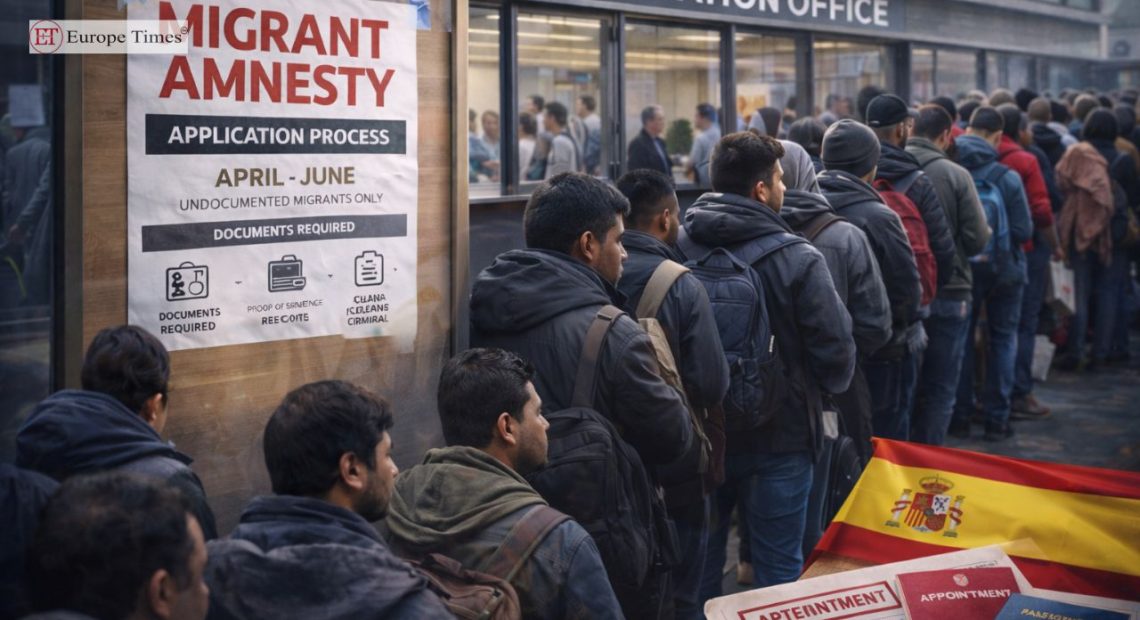
The Spanish government plans to run the programme from April to June, allowing migrants with clean criminal records and at least five months of residence or prior asylum applications to qualify. However, essential details on required documentation and procedures remain unclear. As a result, migrants have been queuing at immigration offices for information and, in some cases, paying intermediaries illegally to secure appointments, reflecting widespread fear and confusion.

Experts note that Spain’s inclusive migration policies have fueled economic growth but chronic administrative backlogs leave hundreds of thousands working off the books. Union officials and NGOs emphasize the need for additional staff, technological support, and extended office hours to handle the surge in applications, while the government explores involving non-governmental organisations and trade unions to manage the expected influx efficiently.

Pic courtesy: google/ images are subject to copyright