
featured Trending

A village-born financier, a global Lions gift and the long argument that prosperity must enrich the soil beneath it.

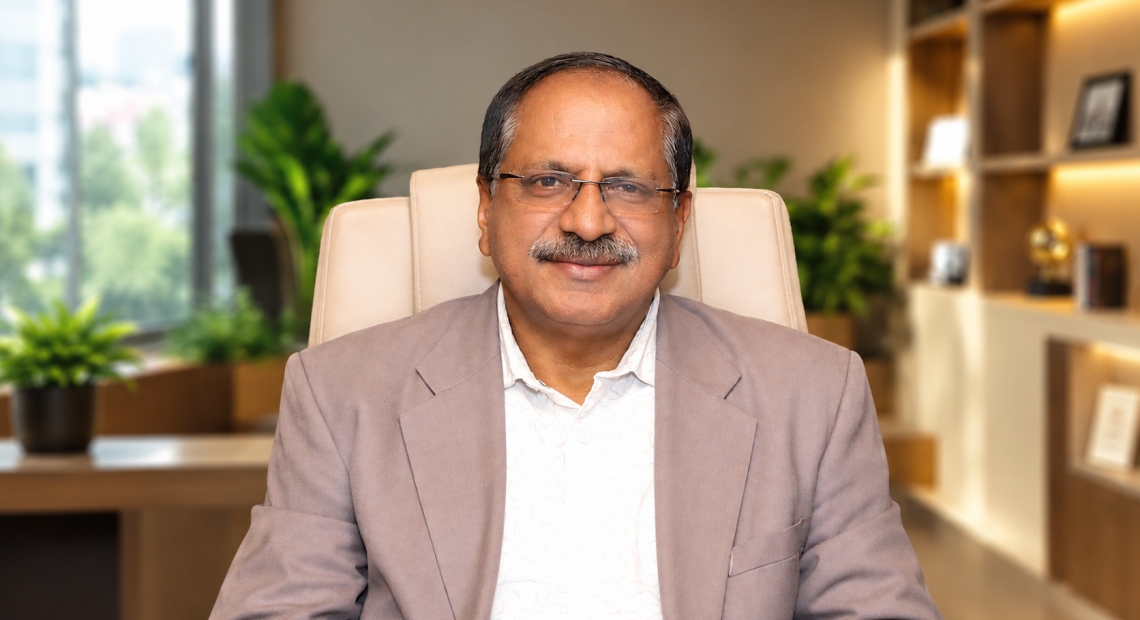
Valapad, Thrissur — In July 2026, Lion V. P. Nandakumar, Chairman and Managing Director of Manappuram Finance Ltd, was recognised on a global stage for a contribution of US$1.5 million to the Lions Clubs International Foundation (LCIF), the charitable arm of Lions International and one of the world’s largest humanitarian service organisations. The recognition came at the Lions International Convention in Hong Kong, where he and his wife, Lion Sushma Nandakumar, were honoured for exceptional humanitarian service. The gift will underwrite LCIF programmes in education, healthcare, disaster relief, youth empowerment, vision care and community development.

Speaking in Hong Kong, Lion Nandakumar said: “Giving back to society has always been at the heart of everything we do. Through this contribution to the Lions Clubs International Foundation, we hope to strengthen humanitarian initiatives that create sustainable and meaningful change in people’s lives across communities. Together, we can build a more compassionate and inclusive future.” The Donation is not a one-off gesture. It is the latest and most international expression of an association with the Lions movement that stretches back more than four decades.

Lion Nandakumar’s ties to Lions Clubs International began in 1981, when he joined the Triprayar Lions Club. He later served as Multiple District Council Chairperson, as a board appointee and as a member of the LCIF Corporate, Foundation and Government Gifts Committee. In July 2019, at the association’s 102nd International Convention in Milan, he was elected International Director. He is now a Past International Director and has received the International President’s Leadership Award, the International President’s Award and the Ambassador of Good Will Award — the highest honour the association confers on its members.

That long association has a practical counterpart at home. In partnership with Lions clubs across Kerala, the Manappuram Foundation runs a housing programme for the homeless and the severely disabled; by late 2025 the collaboration had completed more than 550 houses, with further dwellings under construction. The handover of the 550th home went to a differently-abled beneficiary in Edathiruthy village in Thrissur district. The Lions connection, in this record, is not a ceremonial affiliation. It is the network through which a village trust learned to build at scale — houses, hospital units, flood relief, school kits — without abandoning the local flavour of the original gospel. The US$1.5 million gift to LCIF is the same partnership written in a larger hand.

The Roots Beneath The Reach

That donation is not an exception from Lion Nandakumar’s record. It is the most international expression yet of a philanthropy that still answers to a coastal village called Valapad in Thrissur district, Kerala. Manappuram Finance was founded in 1949 by Lion Nandakumar’s father, Mr V. C. Padmanabhan, in Valapad. From a modest pawnbroking concern it has grown into a non-banking financial company with more than 5000 branches across India. Lion Nandakumar took charge in 1986. He remains Managing Trustee of the Manappuram Foundation, the group’s charitable arm, and has long set aside a substantial share of profit for public purpose. Charity, in his telling, is not an ornament on the business. It is part of the firm’s original bond with the community that first sustained it.

Fabrício Oliveira, Chairperson of the Lions Clubs International Foundation (LCIF), honors Million Dollar Donor V.P. Nandakumar and his spouse Sushama Nandakumar at the Lions International Convention held in Hong Kong

When Lion Nandakumar speaks of giving, the language is local before it is global. His “Gospel of Giving” is rooted in the wellbeing of the neighbourhood: the fishing hamlets, panchayats and small towns around Valapad. The corporate headquarters has never left that village. He has declined to shift it, arguing that proximity is obligation rather than nostalgia. The prosperity of people around the company’s birthplace, he maintains, is a first duty. Beyond that circle lies a wider claim: the poor and the infirm, wherever they are found, deserve organised care.

He has put the idea in the form of a parable. “When a tree grows, its roots will also grow deeper and wider to give it a firm footing. Similarly, when an organisation grows, its prosperity should trickle down to the poor in such a way that it helps create goodwill and brand value among the local populace. Essentially, it provides the company a strong grip on the ground.” An institution’s economic progress, in this view, must register in the neighbourhood as wellbeing, dignity and social harmony.

Before The Statute, A Trust

Soon after he took the helm, Lion Nandakumar concluded that goodwill alone was insufficient. Meaningful intervention required a dedicated instrument. The Manappuram Foundation was constituted in October 2009 as a charitable trust — four years before the Companies Act made CSR spending mandatory for large Indian firms. The vision was concise: healthy, educated and happy communities.

A CSR initiative implemented by Manappuram Foundation in association with LCIF was inaugurated by Lion Gudrun Yngvadottir, LCIF Chairperson, in the presence of V.P. Nandakumar

The first major project was not a ceremonial donation. It was an attempt to close a gap that official schemes had left open. Many below-poverty-line families in the coastal belt of Thrissur were either unaware of existing government health insurance, or unable to pay even the nominal premium. In 2010 the Foundation rolled out the Janaraksha Manappuram Free Health Insurance Scheme. It extended cover of up to Rs 60,000 per family to about 20,000 BPL households — roughly one lakh people — across seven panchayats in the Nattika belt, including Valapad. Over seven years the scheme reimbursed nearly Rs 11 crore in treatment costs, with no age restriction and a wide range of medical procedures. The model predated the Union government’s Ayushman Bharat programme of 2018. It also set the Foundation’s subsequent pattern: identify a local failure of access, fund it properly and stay long enough for the benefit to become visible.

Lives Restored, Not Merely Assisted

Each year the Foundation, drawing on the company’s CSR outlay, attempts to convert that design into individual recoveries. Gopan’s case is one such instance. Bedridden for years after spinal injuries, he left his household in deep distress. With the Foundation’s support he regained his health and now sustains his family through a small business. The episode is typical of the work the Medical Treatment Fund is meant to do: intervene when a medical bill would otherwise collapse a household.

Million Dollar Donor V.P. Nandakumar stands alongside other distinguished donors honoured on stage at the Lions International Convention held in Hong Kong

Similar interventions recur across the Foundation’s case files — dialysis support, assistive devices, scholarships, houses for the landless and the disabled, and seed capital for women who can run a trade if they are given a first chance. The method is unglamorous: identify the person, pay what the system will not, and follow through until the beneficiary can stand without the grant.

The Scale Of The Purse

In FY 2024–25 Manappuram Finance spent more than Rs 46 crore on CSR, meeting and slightly exceeding its statutory obligation. The programmes cut across education, skill development, childcare, art and culture, sports, sustainable livelihood, drinking water and sanitation, digital access, and support for women entrepreneurs. The largest concentrations of money and effort remain healthcare, education and mobility.

Healthcare programmes have reached more than 1.24 lakh people through clinical services, diagnostic infrastructure and community outreach. Education spending has gone into school and academy infrastructure and into scholarships for students from economically weaker families. Under community and environmental heads the Foundation has backed solar installations and waste-management projects. The Chikitsa Sahaya Padhathi, or Medical Treatment Fund, has become the flagship of direct aid. In a single recent year it extended financial assistance to more than 300 patients from BPL and economically weaker households. The wider health brief also covers children with cancer and Type-1 diabetes, persons with intellectual disabilities, burn survivors, the physically challenged and members of the transgender community, as well as palliative care, emergency ambulance services, counselling and psychotherapy, and yoga.

Mobility is treated as a right rather than a concession. The “Wings on Wheels” programme supplies customised three-wheeler scooters to differently-abled beneficiaries; 75 such vehicles were donated in FY 2024–25 alone, at a cost of about Rs 81 lakh. Parallel drives under names such as Sahayathraku Snehasparshamayi have distributed electric wheelchairs to persons with muscular dystrophy and other disabilities. The premise is simple: without movement there is no livelihood, and without livelihood charity becomes a recurring bill rather than a restoration of independence.

Grip On The Ground

In May 2025 Lion Nandakumar received the EdelGive Hurun India Award for Exemplary Leadership in Corporate Social Responsibility. Accepting it, he said that making a difference in even one person’s life is a success in itself. The remark sits beside the tree he likes to describe. The canopy is now a listed NBFC with a national branch network that has made a seven-figure gift to one of the world’s principal humanitarian foundations. The roots are still in Valapad: a health card in a coastal household, a scooter that takes a disabled worker to a shop, a house whose key is handed over by a Lions officer and a Foundation trustee, both standing on the same dais.

V.P. Nandakumar pictured alongside Lion A.P. Singh, International President; Lion Sangeeta Jatia, Board Appointee; and Lion Saju Antony Pathadan, Past Multiple Council Chairperson, Lions International

That is the argument his philanthropy makes, and the standard against which it asks to be judged. Growth that does not thicken the soil beneath it is, in this telling, only height. The work of the Manappuram Foundation — and the Hong Kong recognition that now travels with the Lions movement — is an attempt to prove the contrary: that a firm can rise, give across continents and still keep its footing among the people who first gave it ground.

The landmark donation will continue to support and nature global humanitarian assistance for the needy.

Pic courtesy: Pegaus photography/ images are subject to copyright