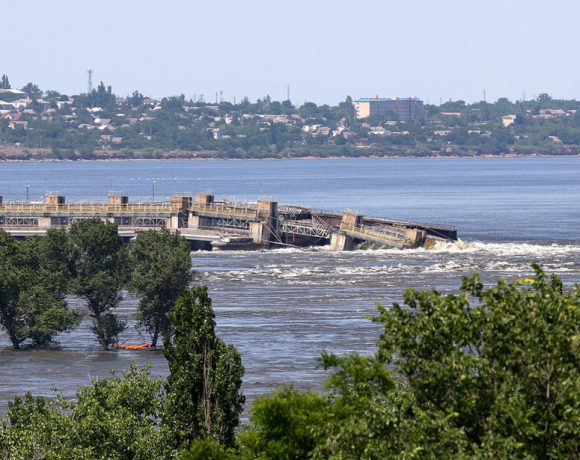
Massive flooding brought on by a dam break has polluted the water supply, making swimming and eating shellfish prohibited.
Offers by the UN to assist those in Russian-occupied territories impacted by floods from the collapsed Nova Kakhovka Dam have been refused by Moscow.
On June 6, the dam collapsed, sending a flood of water from the Dnipro River on towns throughout southern Ukraine, including areas of the Kherson region that are under Russian occupation.
The floods drove thousands of people to evacuate, devastated houses and agriculture, poisoned drinking water sources, and raised concerns about an impending environmental catastrophe.
The UN called on Russia to follow its commitments under international humanitarian law.
“The UN will continue to do all it can to reach all people – including those suffering as a result of the recent dam destruction – who urgently need life-saving assistance, no matter where they are,” UN humanitarian coordinator for Ukraine Denise Brown said in a statement on Sunday.
“People in need cannot be denied aid.”
The number of fatalities from the tragedy has increased to 52; according to Russian officials, 35 people died in regions under their control, and the interior ministry of Ukraine, 17 people died and 31 were missing. On both sides, more than 11,000 people have been evacuated.
Having been under Russian control since the beginning of its full-scale invasion in 2022, Ukraine accuses Russia of blowing up the Soviet-era dam.
According to a group of foreign legal experts supporting Ukrainian prosecutors in their investigation, it is “highly likely” that Russian explosives were used to cause the dam to collapse.
Using drone footage and data from local military and political sources, the Associated Press stated that Russia has “the means, motive, and opportunity” to demolish the dam.
Russia has blamed Ukraine for the dam rupture, but the different Russian claims, such as that it was hit by a missile, are insufficient to explain a boom that was so powerful that it was detected by seismic detectors in the area.
When the explosion occurred, Ukraine was getting ready to begin its counteroffensive, and the Dnipro River served as the front line.
As the rising floods quickly engulfed their positions, Bugskiy Gard commander Illia Zelinskyi said, “It’s a regular practise to mine (places) before a retreat.” In this situation, their activities complicated for us a passage of the Dnieper (Dnipro) and disrupted parts of our supply networks.
The explosion appeared to originate from the region where the dam’s machine room was located, Zelinskyi told the news agency. He said that Russian soldiers had been present for some time, as did a senior American official who was acquainted with the intelligence. To discuss sensitive information, the US official spoke on the condition of anonymity.
Photos obtained by the AP from Ukrainian drone footage also showed scores of Russian soldiers tented on a Dnipro bank, seeming at ease as they made their way back and forth to the dam without any protection.
In another image from May 28, a vehicle was parked on the dam with its roof torn open to reveal large barrels, one of which had what seemed to be a land mine attached to the lid and a cable leading to the Russian-controlled side of the river.
While the vehicle bomb alone would not have been sufficient to damage the dam, any explosion coming from the machine room would have been magnified, a Ukrainian special forces communications official told the news agency.
Popular Black Sea bathing beaches in Odesa were already forced to close due to the release of the now-contaminated water, and the consumption of fish and shellfish from unconfirmed sources was outlawed.
The water at Odesa’s beaches has significantly deteriorated, and the city’s government has deemed them unsafe for swimming because of the potential health risks.
Salmonella and other “infectious agents” were detected in water samples last week at dangerously high levels, according to Ukrainian officials. There was also cholera surveillance in place.
On the seabed and in marine animals, harmful chemical concentrations are predicted to rise. Land mines washing up along the shoreline is another worry.
Picture Courtesy: Google/images are subject to copyright