News Trending

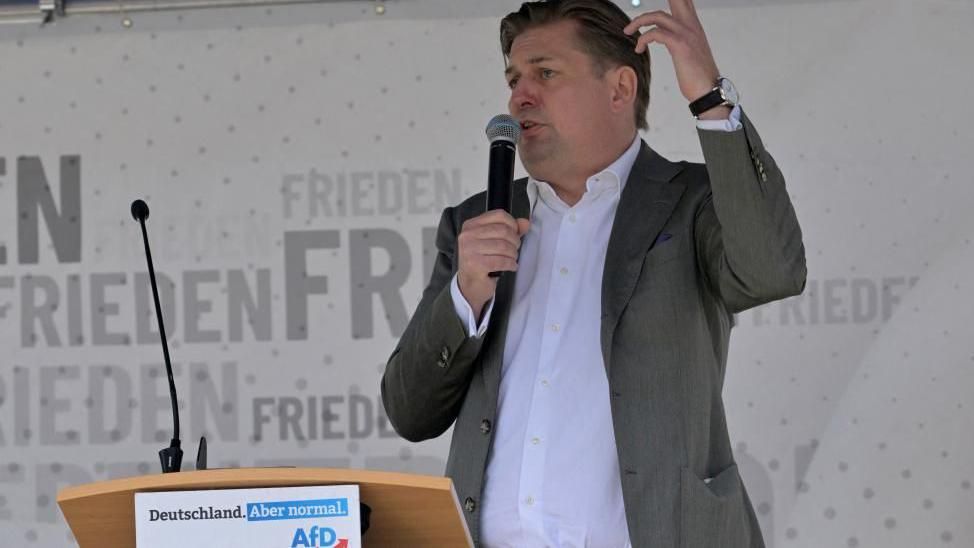
Maximilian Krah, a prominent far-right German politician from the Alternative for Germany (AfD), announced he would scale back his campaign efforts for the upcoming EU elections while remaining the party’s lead candidate. This decision followed a controversial interview with the Italian newspaper La Repubblica, where Krah remarked that not all SS members were automatically “criminals” and emphasized assessing individual culpability. He referenced Günter Grass, the German novelist who served in the Waffen SS, to support his point.

The SS, or Schutzstaffel, was a Nazi paramilitary group notorious for its central role in the Holocaust and other war crimes. Krah’s comments provoked a strong reaction, leading France’s far-right National Rally (RN) to sever ties with the AfD in the European Parliament. RN leader Marine Le Pen called for a “cordon sanitaire” to distance her party from the AfD, stating the urgency of this separation due to the extremity of Krah’s views.

The relationship between RN and AfD had already been strained following a secret meeting involving AfD members discussing the mass deportations of non-ethnic Germans. Marine Le Pen had previously condemned such ideas.

Facing mounting pressures ahead of the EU elections in June, Krah declared on social media that he would step back from public campaign appearances and resign from the federal executive board to preserve party unity. This decision comes amid various scandals, including the arrest of one of his staffers for alleged espionage for China and an ongoing investigation into Krah over purported payments from Russia and China, which he denies. Despite these controversies, the AfD remains a significant political force, polling second or third nationally and leading in some states set for local elections later this year.

Picture Courtesy: Google/images are subject to copyright

News Trending

The French parliament has recently passed a more stringent immigration law, culminating months of political negotiations. Both President Emmanuel Macron’s centrist Renaissance party and Marine Le Pen’s far-right National Rally (RN) supported the amended bill, creating a significant majority in the lower house. Despite accusations from the left that Macron made concessions to the far-right, the ruling party’s overwhelming majority rendered support from Le Pen unnecessary. Macron had underscored his reluctance to owe victory to the RN, expressing a preference for a new reading of the bill instead of relying on their backing.

Some key provisions in the new legislation include making it more challenging for migrants to bring family members to France and delaying their access to welfare benefits. These measures aim to address concerns related to immigration and welfare systems. An earlier draft of the bill failed when MPs from the far-left and far-right opposed it for different reasons, showcasing the contentious nature of immigration policy in France.

Human rights groups have strongly criticized the amended law, denouncing it as the most regressive immigration legislation in France in decades. Critics argue that the measures undermine fundamental values, raising concerns about the impact on vulnerable migrant populations. Despite the opposition, the bill received support from conservatives who applauded its firmness and courage in addressing immigration challenges.

While Marine Le Pen’s far-right National Rally welcomed the amended bill, left-wing voices expressed disappointment, accusing Macron of enabling the far-right and signaling a shift in the country’s history and fundamental values. French Communist Party leader Fabien Roussel argued that the legislation, directly inspired by RN’s anti-immigration stance, represented a concerning departure for the republic.

Emmanuel Macron’s centrist Renaissance party lost its majority in parliament in June 2022, leading to challenges in passing legislation. Since then, the government has frequently found itself unable to secure necessary votes in parliament, highlighting the complex political landscape surrounding immigration policy in France.

Picture Courtesy: Google/images are subject to copyright

News Trending

In an unprecedented turn of events in Paris this weekend, a significant demonstration took place in response to the Israel-Hamas conflict, drawing representatives from major political parties. Notably, the far right, including Marine Le Pen and Jordan Bardella of the National Rally, participated, while the far left, led by Jean-Luc Mélenchon of France Unbowed, boycotted the event, citing it as a gathering for supporters of the Gaza massacre.

This shift is symbolic, considering historical political dynamics in France. Traditionally, the far right was ostracized due to its perceived anti-Republican views, especially on Jewish issues. The far left, on the other hand, despite criticism, remained part of the broader political spectrum. However, the current scenario reflects a shake-up in the political landscape.

The contemporary far right in France, now labeled as “hard right” or “national right,” has shifted focus from past anti-Semitic stances to prioritize issues such as immigration, insecurity, and Islamism, aligning with some Jewish perspectives. Meanwhile, the far left interprets the Gaza conflict through an anti-colonial lens, emphasizing solidarity with the oppressed against perceived superpower aggression.

This unusual alignment sees a party with a history of Holocaust denial, like the National Rally, supporting French Jews openly. Conversely, a party built on human rights and equality, like France Unbowed, faces accusations of antisemitism for not condemning Hamas as a terrorist organization.

While nuances exist, the overall trend shows the National Rally under Marine Le Pen successfully integrating into the mainstream, while France Unbowed under Jean-Luc Mélenchon appears to be distancing itself. Opinion polls reinforce this, with Marine Le Pen leading in presidential election polls, while Mélenchon’s support has declined.

Serge Klarsfeld, a prominent figure in the fight against antisemitism in France, acknowledges the irony. He appreciates the far right’s departure from antisemitism, seeing it align with Republican values, yet expresses sadness over the far left’s perceived abandonment of efforts to combat antisemitism.

Picture Courtesy: Google/images are subject to copyright