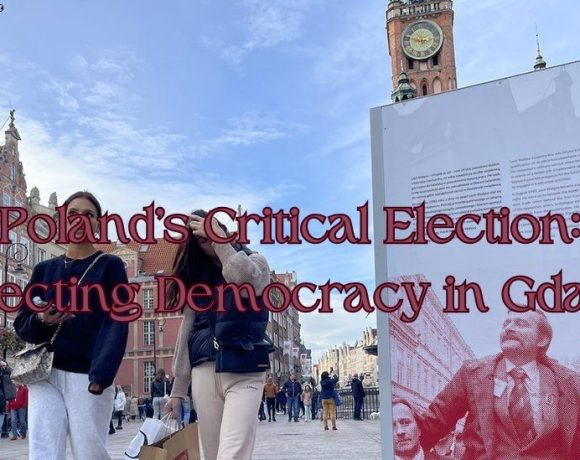
In the old Lenin shipyard in Gdansk, where striking workers were once the catalyst for major political change, young Poles now debate how to protect democracy in their country.
They worry that the rights and freedoms won by the Solidarity movement over three decades ago are at risk, as the ruling right-wing Law and Justice party, or PiS, campaigns to secure a record third term in office.
“It’s a very important election. We’re deciding whether we’re going back to being a democratic country,” was student activist Julia Landowska’s stark take on this weekend’s vote.
“This is our last call, to go to the election and fight for a better future in Poland.”
The event she helped organise was held under the slogan In My Day, Things Will Be Better.
A mixture of discussions and live music topped off with a silent disco, it was designed to encourage reluctant younger voters to the polls.
The activist’s worries are echoed by others in Gdansk, who point to the shrinking independence of the courts under a PiS government and backsliding on women’s rights, including a near-total ban on abortion.
There is also concern about media freedom – publicly-funded TV becoming a government mouthpiece – as well as acrimonious wrangling with Brussels on issues from judicial reform to migration.
That is why many Poles are now hailing the election on 15 October as the most important since 1989, when Solidarity candidates swept the board in the first partially-free vote since communist rule.
Freedom City The story of Poland’s struggle for freedom dominates the northern port city of Gdansk.
There is a Solidarity museum in the shipyard once occupied by strikers and billboards through the city centre that recount the momentous changes brought by their protest, led by an electrician named Lech Walesa.
This year, his son is running for re-election.
“We have to make sure we win, to reform all that has been destroyed in eight years,” Jaroslaw Walesa explained, referring to the two terms PiS have held office so far.Representing the opposition Civil Coalition, like fellow Gdansk-native and party leader Donald Tusk, he is most worried by Poland’s increasingly antagonistic relations with the EU.
Like Brussels, he is also concerned about the politicisation of Polish courts.
“If you look at what has been done to our democracy, we took a huge step backwards. That’s definitely not what my father fought for,” Mr Walesa told the BBC this week, wandering the paths of the handsome Oliwki park, greeting voters with leaflets and a promise of change.
The 1989 slogan – Don’t sleep, or they’ll outvote you! – has been resurrected in Gdansk for this election, all part of pitching it as another critical moment for Polish democracy.
The city is expected to vote solidly for the opposition, as usual.
But opinion polls put the governing Law and Justice Party ahead nationwide, although probably without a big enough majority to form a government.
So the last-minute battle for votes is intense.
PiS and Security In the town of Elblag, a short drive from Gdansk, campaigners spent Saturday canvassing for the governing party at a food market.
Between piles of potatoes and giant pumpkins, they dished out bags printed with the PiS logo and leaflets promoting the city’s main candidate, who didn’t show up.
“PiS have a good programme for us young people and for my children. I have twins and they’ve got a good programme for our future,” party activist Monica explained, referring to the 500 zloty (£95) monthly child benefit the government now pays.
It is set to rise to 800 next year if PiS win.
“In Poland, this amount can solve many things,” her husband added.Neither accepted the opposition’s fears for the future of democracy in Poland. “Democracy is good for us,” Monica said – and she wants to stay in the EU.
The pair both talked about security, including the government’s slogan that it is “protecting the future of Poles”.
“We’re not ready to accept immigrants. Muslims,” Monica clarified, adding that Poland had already taken in “a lot of Ukrainians”, meaning those who came in 2022 as refugees.
The Russian exclave of Kaliningrad is nearby and there is a new barbed-wire fence along its entire length.
The activists’ pro-government message was not universally welcomed by marketgoers, even though the Elblag regional vote was strongly pro-PiS at the last election.
Several shoppers thrust the free bags back when they realised which party logo was printed on them. Others retorted that PiS had been so good for Poland that their children had moved abroad for better opportunities.
Picture Courtesy: Google/images are subject to copyright