featured News

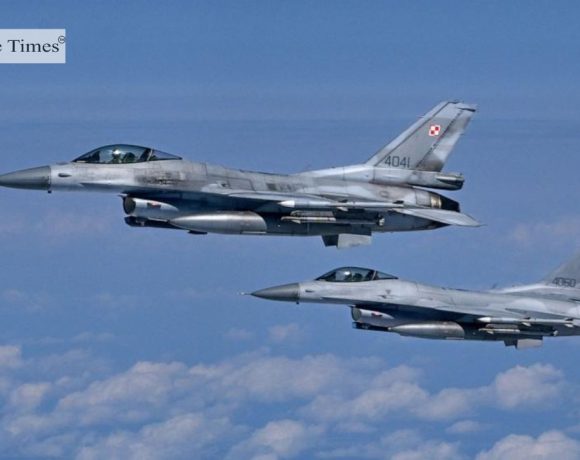
Poland activated its air defence and scrambled fighter jets early Wednesday after Russia launched a wave of airstrikes on western Ukraine, close to the Polish border. The Polish Armed Forces said quick-reaction fighter jets and an early-warning aircraft were deployed to secure national airspace.

In a statement on X, Poland’s operational command confirmed that ground-based air defence units and radar systems were raised to their highest state of readiness amid heightened tensions along NATO’s eastern flank.

The response followed widespread air raid alerts across Ukraine around 0400 GMT, as the Ukrainian Air Force warned of incoming Russian missile and drone attacks.

Pic Courtesy: google/ images are subject to copyright

featured News

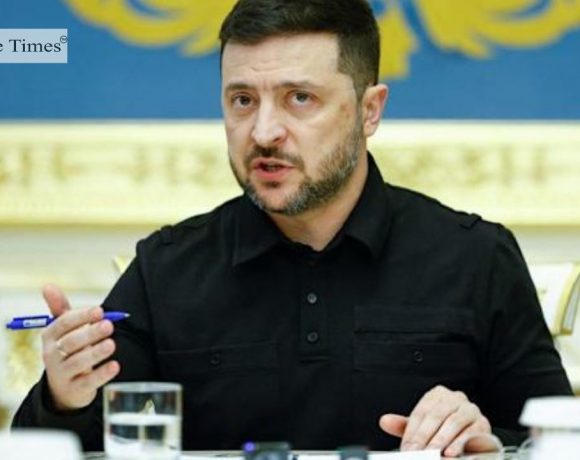
Ukraine will begin importing US liquefied natural gas through Greece this winter, using the Trans-Balkan pipeline to help stabilise its energy supply amidst ongoing Russian attacks. The announcement followed a meeting in Athens between Ukrainian President Volodymyr Zelensky and Greek Prime Minister Kyriakos Mitsotakis, who emphasised Greece’s growing role in supplying American LNG to reduce regional dependence on Russian gas.

Zelensky said the first deliveries are expected in January, noting that Ukraine urgently needs external supplies to offset the damage inflicted on its domestic gas infrastructure. Kyiv has allocated close to €2bn—backed by European Commission guarantees and bank financing—to secure gas imports through March. The deal comes as the EU pushes toward a complete halt of Russian gas imports by 2027.

During his European tour, Zelensky also met French President Emmanuel Macron and signed a letter of intent for Ukraine to potentially acquire up to 100 Rafale fighter jets, along with air defence and radar systems. The visit highlighted Ukraine’s dual battlefronts—strengthening its military capabilities while preparing for a harsh winter as Russia intensifies attacks on energy facilities and multiple regions report continued casualties.

Pic Courtesy: google/ images are subject to copyright

News Trending

In the western Transcarpathian region of Ukraine, a shocking incident unfolded during a village council meeting in Keretsky when a councillor threw grenades, injuring a total of 26 people. The meeting, which was livestreamed on Facebook, centered around discussions on the 2024 budget and financial results for the current year. The attacker’s motive remains unknown, and police have yet to provide details on the possible reasons behind the assault.

The chaotic scene unfolded approximately 90 minutes into the meeting when one councillor, visibly agitated about the budget discussions, abruptly left the room and returned with grenades. In a chilling sequence captured on the livestream, the assailant briefly attempted to attract attention, uttering “May I, may I?” before hurling the grenades into the meeting. The resulting explosion left six individuals in critical condition, while the broader community of Keretsky, with a population of around 4,000, grapples with the aftermath of this unforeseen act of violence.

Despite Ukraine’s ongoing conflict with Russia and widespread access to weaponry, there is currently no evidence linking this attack to the geopolitical tensions in the region. The village of Keretsky, situated not far from the Hungarian border, now finds itself in the midst of an investigation as Ukrainian police designate the incident as a “terrorist attack.” The SBU security service will lead the inquiry into this shocking act, with authorities seeking to understand the motives behind the councillor’s violent actions.

As the investigation unfolds, it has been reported that the assailant, who is now in serious condition, was promptly taken to a hospital and admitted to an intensive care unit. The incident has left the community in shock and raises questions about the safety and security of local government meetings. The repercussions of this violent event will undoubtedly reverberate through the village and the broader region as authorities work to piece together the motives behind this unsettling act of aggression.

Picture Courtesy: Google/images are subject to copyright

News Trending

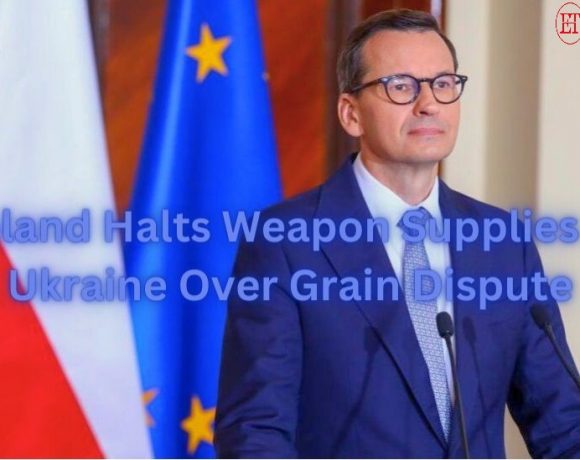
One of Ukraine’s steadfast supporters, Poland, has declared that it will cease its weapon supplies to its neighboring country, Ukraine, citing a diplomatic dispute regarding Ukraine’s grain exports as the primary reason. Prime Minister Mateusz Morawiecki emphasized that Poland’s current focus is on bolstering its own defense capabilities with more modern weaponry.

Poland had already provided Ukraine with significant military assistance, including 320 Soviet-era tanks and 14 MiG-29 fighter jets. However, their willingness to continue such support has dwindled, coinciding with escalating tensions between the two nations.

The recent diplomatic rift was triggered when Poland, along with Hungary and Slovakia, extended a ban on Ukrainian grain imports. Ukrainian President Volodymyr Zelensky’s comments at the United Nations, characterizing their actions as political theater, added fuel to the fire. Poland viewed these remarks as unjustified, given their longstanding support for Ukraine.

In his interview, Prime Minister Morawiecki underlined that while Poland remains committed to assisting Ukraine in its struggle against Russian aggression, it could not allow its own markets to be destabilized by Ukrainian grain imports. He pointed out that Poland was already replacing its depleted military hardware, which had been significantly reduced through transfers to Ukraine, with modern Western-produced equipment.

While arms exports to Ukraine will not cease entirely, only previously agreed deliveries of ammunition and armaments, including those from existing contracts with Ukraine, will be fulfilled. This decision reflects Poland’s commitment to its own security and stability, while the future of its assistance to Ukraine remains uncertain.

The ongoing grain dispute arises from Ukraine’s need to find alternative overland routes for grain exports due to Russia’s full-scale invasion, which nearly closed the main Black Sea shipping lanes. Consequently, large quantities of grain flowed into Central Europe, leading the European Union to temporarily ban grain imports into several countries. Despite the EU lifting the ban, Poland, Hungary, and Slovakia have maintained it, leading to Ukraine’s WTO lawsuits against these nations. Poland has signaled its intention to uphold the ban, while also hinting at the possibility of expanding the list of banned products should Ukraine escalate the grain dispute. However, diplomatic channels remain open, with discussions ongoing to seek a mutually beneficial solution.

Picture Courtesy: Google/images are subject to copyright