featured News Trending

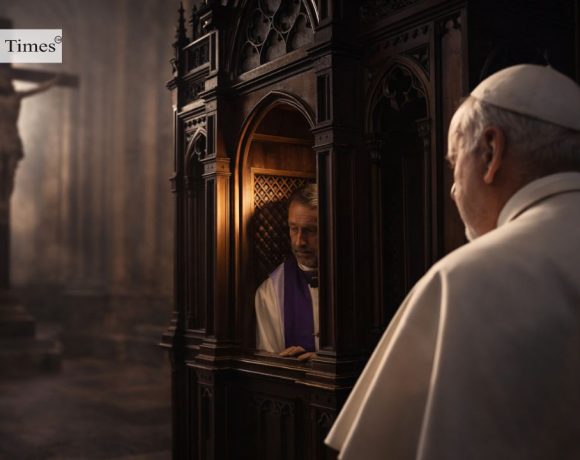
Pope Leo XIV on Friday suggested that Christian political leaders who engage in armed conflicts should examine their conscience and go to confession, emphasizing adherence to Jesus’ teachings without naming specific leaders or wars. Speaking to priests at a Vatican conference on the practice of confession, he highlighted the importance of humility and moral reflection for those bearing grave responsibilities in conflicts.

The pope’s remarks come amid his repeated calls for an end to the ongoing Iran war, which began with joint U.S.-Israeli airstrikes on February 28. While the Catholic Church generally opposes war, it evaluates conflicts through the just war tradition, assessing whether actions like repelling an unjust invasion are morally justifiable. Cardinal Robert McElroy recently criticized the U.S.-Israeli strikes as failing to meet these criteria.

Pope Leo stressed that the sacrament of confession not only allows individual Catholics to seek forgiveness but also fosters peace and unity in society. By encouraging self-examination and repentance, the pope linked spiritual reflection with broader ethical responsibility, urging leaders and faithful alike to align their actions with Christian teachings on non-violence.

Pic courtesy: google/ images are subject to copyright
News Trending

A recent official investigation into the Roman Catholic Church in Switzerland has revealed nearly 1,000 cases of sexual abuse dating back to 1950. The report, compiled by researchers from the University of Zurich, found that the majority of victims were children, with 56% of them being male. Most of the accused individuals were men, and there was also evidence of a widespread cover-up within the Church.

The study, which was commissioned by Church authorities and conducted over a year, granted access to Church archives and included interviews with victims of sexual abuse. However, the researchers noted that many relevant documents had not been provided. They also uncovered instances of records being destroyed in two dioceses, and some cases of abuse were not documented or archived.

The report suggests that the identified cases represent only a fraction of the actual abuse cases, as many likely went unreported. A significant portion of the abuse occurred during pastoral activities, such as confession, altar service, and religious education in children’s clubs and associations. About 30% of the abuse took place within institutions like Catholic children’s homes, day schools, and boarding schools.

The researchers criticized Church officials, including bishops, for their inadequate response to these cases, often keeping them secret, covering them up, or downplaying their significance. They found evidence of clerics accused of abuse being systematically reassigned to different roles, sometimes abroad, to avoid prosecution, prioritizing the Church’s interests over the safety of parishioners.

This culture of secrecy and protection persisted until the 21st century, when various sex abuse scandals began to surface. Groups representing sexual abuse victims expressed their disappointment in the Church’s actions over the decades, accusing it of prioritizing the institution’s reputation over the well-being of victims.

In response to the report, the president of the Swiss Bishops’ Conference acknowledged that the organization had made numerous excuses and had fallen short in its response to victims’ needs. Church authorities pledged to fund a follow-up project by the University of Zurich, set to begin in 2024.

Picture Courtesy: Google/images are subject to copyright

News Trending

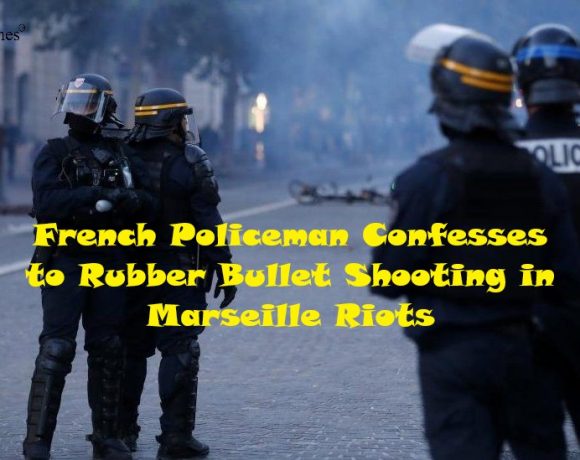
French policeman under investigation for a shooting incident during the Marseille riots a month ago has confessed to firing a rubber bullet at a 22-year-old man’s head. The victim, Hedi, an assistant restaurant manager, suffered severe injuries and disfigurement from the “flash ball.”

The officer has been in custody for weeks, causing controversy among his colleagues. The officer’s lawyer requested his release, but the public prosecutor cited the risk of collusion with colleagues. The incident occurred during nationwide riots that followed the death of a 17-year-old during a police check in Nanterre.

Hedi, a North African immigrant, survived the headshot but sustained serious health issues. Other incidents of rubber bullet use by the French police have also resulted in life-changing injuries and deaths, sparking further debate on their use.

Picture Courtesy: Google/images are subject to copyright