
featured News Trending

The government of France has announced plans to offset the financial impact of the ongoing Iran crisis by freezing public spending. Rising energy prices and increased borrowing costs linked to the crisis are expected to cost the country between €4 billion and €6 billion. Authorities say the spending freeze will match these projected losses, helping stabilize public finances.

Finance Minister Roland Lescure stated that higher bond yields alone could add €3.6 billion to France’s borrowing costs. Meanwhile, the government is preparing targeted support measures to help households cope with surging energy prices. These measures are expected to prioritize workers who rely heavily on fuel, reflecting growing concerns over the cost-of-living impact.

Despite the planned response, the government faces mounting political pressure for broader relief measures. While some groups are calling for fuel tax cuts, others are pushing for caps on energy prices. However, with one of the largest budget deficits in the eurozone, officials insist that any support must remain limited and carefully targeted to avoid further straining public finances.

Pic courtesy: google/ images are subject to copyright

featured News Trending

Italy is set to lower its economic growth forecasts as rising energy prices continue to pressure its economy, Economy Minister Giancarlo Giorgetti said. The government is expected to trim this year’s GDP growth estimate to around 0.5%–0.6%, down from 0.7%, while next year’s outlook may also be reduced slightly. The slowdown is largely attributed to external and temporary factors, particularly the ongoing energy crisis.

The weaker growth outlook complicates Italy’s efforts to reduce its budget deficit below the European Union’s 3% threshold. With the deficit already projected at 3.1% in 2025, slower expansion could limit fiscal room and make it harder to meet agreed targets. Despite these challenges, officials maintain that recent data does not indicate any structural weakness in the economy.

Italy has urged the European Union to consider temporarily easing its budget rules if geopolitical tensions, especially involving Iran, worsen further. While existing mechanisms allow flexibility during severe downturns, current conditions do not yet meet that threshold. Meanwhile, Italy remains under EU scrutiny for its deficit, restricting its ability to introduce major relief measures.

Pic courtesy: google/ images are subject to copyright

featured News Trending

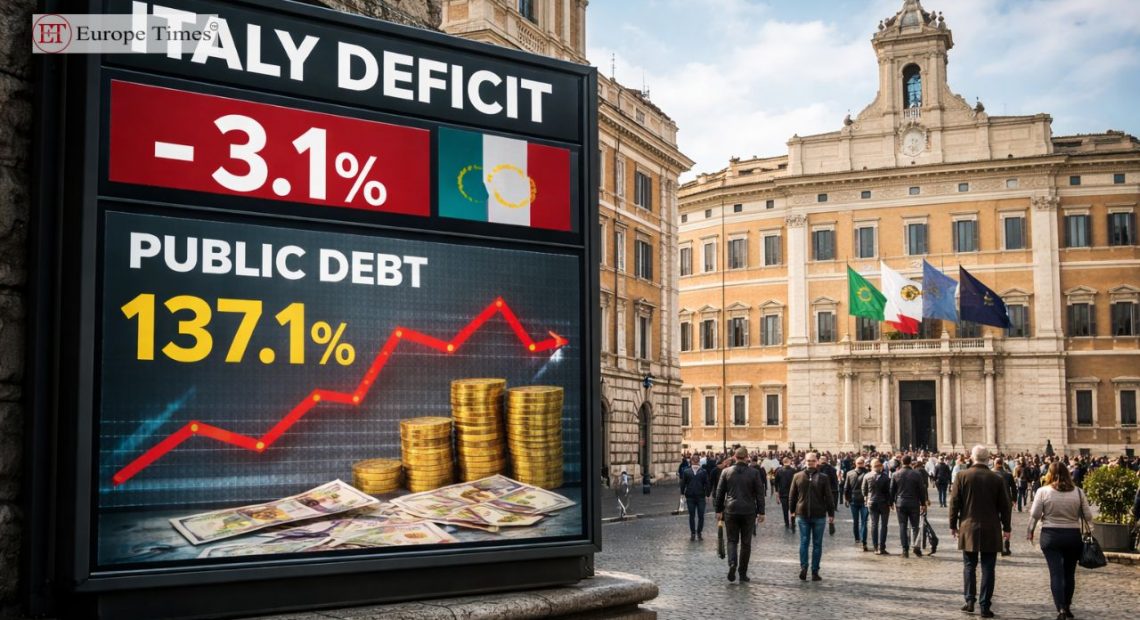
Italy’s 2025 budget deficit came in at 3.1% of GDP, slightly above the European Union’s 3% ceiling, according to ISTAT. While lower than 2024’s 3.4%, the miss casts doubt on Rome’s plan to exit the EU’s Excessive Deficit Procedure early, which could have eased spending constraints ahead of the 2027 elections.

The eurozone’s third-largest economy grew by 0.5% in 2025, matching the government’s revised forecasts, though growth remains below 1% for the fourth consecutive year despite EU recovery funds. The 2026 deficit is targeted at 2.8%, with the government hoping for modest improvement amid lingering fiscal challenges.

Italy’s public debt also exceeded expectations, rising to 137.1% of GDP from 134.7% in 2024, above the government’s 136.2% target. With debt levels remaining the second-highest in the eurozone after Greece, the Meloni administration faces mounting pressure to control spending while promoting economic growth.

Pic courtesy: google/ images are subject to copyright