featured News Trending

Russia launched missile and drone attacks on Kyiv and other regions of Ukraine on Saturday, coinciding with heightened security measures ahead of President Volodymyr Zelensky’s key meeting with U.S. President Donald Trump in Florida. Ukraine’s air force issued a nationwide alert as explosions were heard in the capital, prompting air defense units to intercept incoming missiles and drones. No immediate reports of damage or power outages were recorded.

The attacks come amid ongoing diplomatic efforts to finalize a U.S.-backed 20-point peace plan aimed at halting the war that began with Russia’s invasion in February 2022. Zelensky emphasized that his discussions with Trump would focus on territorial control, including the contested Donetsk and Luhansk regions, as well as security guarantees. Kyiv seeks legally binding provisions to prevent future Russian aggression, while a free economic zone is proposed for certain areas under U.S. compromise.

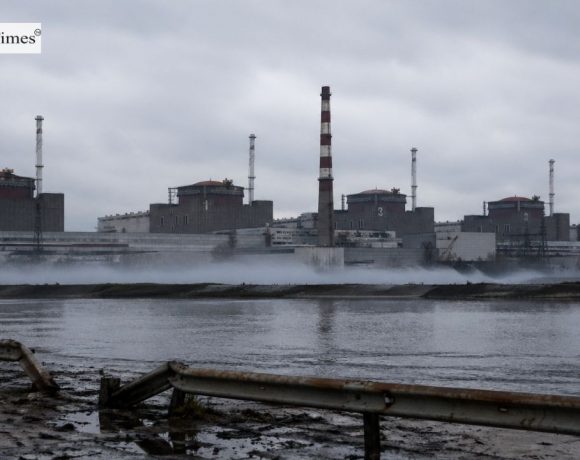
Additional issues include control of the Zaporizhzhia nuclear power plant and the eastern Donbas region, both key points of contention in the negotiations. Russia’s foreign policy aide, Yuri Ushakov, engaged with U.S. officials after Moscow received American proposals for a possible peace deal, although Russia has not publicly disclosed its stance on the documents. Both sides continue dialogue as efforts to resolve the nearly four-year conflict move forward.

Pic courtesy: google/ images are subject to copyright

featured News

Ukraine is set to present a revised peace proposal to the United States, aiming to avoid territorial concessions to Russia. President Volodymyr Zelensky reiterated that ceding land is not an option, citing Ukrainian law, the constitution, and international law. His comments came during meetings with European and NATO leaders, amid ongoing diplomatic efforts to secure a peace deal without compromising Ukraine’s sovereignty.

The revised plan follows intensive weekend talks between US and Ukrainian negotiators that failed to yield an agreement acceptable to Kyiv. Zelensky emphasized that sensitive issues like control of the Donbas region and the Zaporizhzhia nuclear power plant remain non-negotiable. The original US-backed draft, which proposed handing over full control of Donbas to Russia and splitting energy from Zaporizhzhia, has been trimmed from 28 to 20 points, with no compromise on territorial matters.

Meanwhile, fighting continues along the front line, including a drone attack on Sumy that cut power but caused no casualties. Zelensky’s European tour included meetings with leaders in London and Brussels to secure support and potential security guarantees for Ukraine. Talks with Moscow reportedly remain ongoing, though little progress has been publicly acknowledged, and the US seeks a resolution ahead of the 2024 presidential elections.

Pic courtesy: google/ images are subject to copyright

featured News

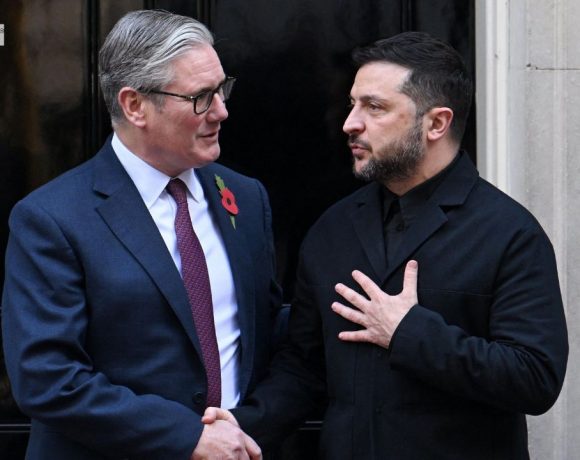
Ukrainian President Volodymyr Zelensky is set to meet UK Prime Minister Sir Keir Starmer, along with French President Emmanuel Macron and German Chancellor Friedrich Merz, at Downing Street. The discussion comes amid a US-driven push for Ukraine to accept concessions in peace talks with Russia. The meeting follows negotiations in Florida, where Zelensky’s team pushed to amend a White House plan that Ukraine believes leans too heavily toward Russian demands.

The talks aim to ensure that any peace deal comes with strong security guarantees capable of deterring future Russian aggression. The UK and France have been spearheading efforts to build a “coalition of the willing” to support Ukraine’s long-term defence, though the role of a future reassurance force in Ukraine remains unclear. Some European countries, including Germany, have expressed reservations about deploying troops on Ukrainian soil, fearing escalation.

Key sticking points in the US-led peace initiative include Ukrainian troop withdrawal from contested eastern regions and the future of the Zaporizhzhia nuclear power plant, currently under Russian control. While US officials claim progress is being made, Russia shows little sign of compromise and continues to insist on retaining occupied territories and blocking Ukraine’s NATO ambitions. European leaders fear the proposed terms could prioritise a quick end to the war over long-term European security.

Pic courtesy: google/ images are subject to copyright

News Trending

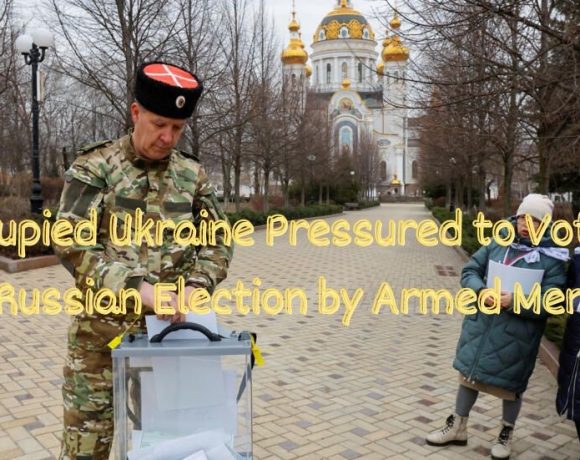
Moscow is orchestrating a significant effort urging residents in occupied parts of Ukraine to participate in Russia’s presidential election. The election, spanning three days for the first time, is being supplemented with early voting in regions under occupation, including Zaporizhzhia, Kherson, Donetsk, and Luhansk.

Reports indicate coercion tactics, with pro-Russian collaborators and armed soldiers visiting households with ballot boxes to encourage voting. While Vladimir Putin’s victory seems assured, a high turnout would bolster Kremlin’s legitimacy and potentially justify Russia’s invasion of Ukraine.

Residents are pressured through various means, including home visits by electoral representatives accompanied by armed individuals, data collection, and filming. Despite resistance and attacks on election organizers, Moscow continues to promote the vote as an endorsement of Putin’s leadership, using symbols associated with the Ukraine conflict.

However, critics denounce the process as undemocratic and farcical, citing intimidation tactics, forced participation, and the absence of genuine opposition. Many residents, fearful of repercussions, reluctantly comply with the orchestrated election process.

Picture Courtesy: Google/images are subject to copyright

News Trending

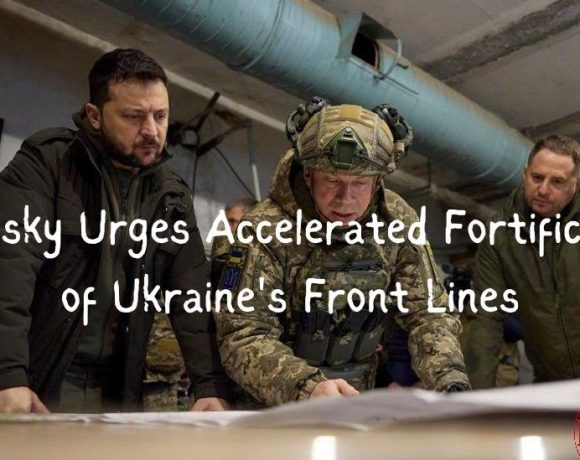
Ukrainian President Volodymyr Zelensky has emphasized the urgent need to strengthen defenses along the front line following meetings with commanders in key areas of tension in the south and east. Russian forces are attempting to encircle the eastern town of Avdiivka, targeting southern regions like Kherson and Zaporizhzhia. President Zelensky, in his nightly address, highlighted the importance of accelerating the construction of structures in sectors requiring reinforcement. Despite Ukraine’s air force claiming success in downing 18 out of 25 Russian drones and one cruise missile, the situation remains challenging, especially with temperatures dropping below freezing.

Zelensky acknowledged that winter introduces a new phase of the war, and he pledged “maximum attention” to eastern towns under fire, the Donetsk region, and the defensive line in the north-east. Concerns are rising about the possibility of a “frozen” conflict despite ongoing fierce fighting. The failure of Ukraine’s counter-offensive since the summer to achieve desired gains has raised questions about frontline morale. The military reported repelling 20 attacks near Avdiivka, which is almost encircled by Russian forces. The town’s industrial hub faces threats, with Russian forces aiming to seize a nearby coke plant.

In the south-east, Russian forces are attempting to regain lost areas around Robotyne, but Ukrainian officials claim to maintain positions on the east bank of the River Dnipro. Zelensky expressed dissatisfaction with casualties and the insufficient supply of weapons. Despite facing challenges, Ukrainian forces managed to regain control of the village of Krynky after crossing the Dnipro, facing relentless Russian attacks. Russia’s defense ministry reported repelling a Ukrainian naval attack on occupied Crimea via the Black Sea, while parts of the peninsula were placed under a state of emergency due to storm-related deaths.

Picture Courtesy: Google/images are subject to copyright

News Trending War

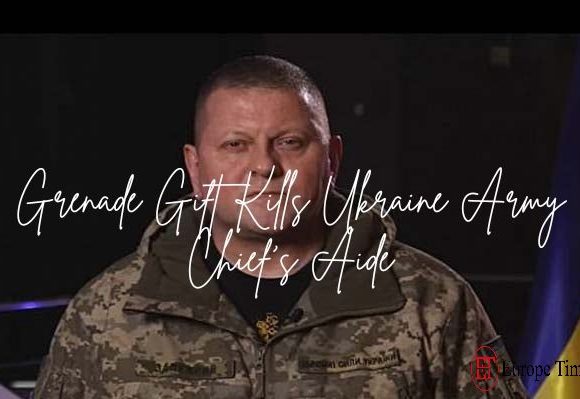
A tragic incident recently occurred in Ukraine, resulting in the death of Major Hennadiy Chastyakov, a close aide to the head of Ukraine’s armed forces, Valery Zaluzhny. The incident took place during Chastyakov’s birthday celebration, where a grenade from a colleague exploded, causing his death and seriously injuring his 13-year-old son. Initial reports suggested that Chastyakov had triggered the grenade while trying to take it away from his son, but subsequent investigations revealed that it was an accident.

The Ukrainian Interior Minister, Ihor Klymenko, urged the public to await the official investigation, calling the incident a “tragic accident” resulting from the mishandling of ammunition. However, it was later discovered that there were five more grenades in Chastyakov’s flat, allegedly presented as gifts from a fellow army officer. Two similar grenades were found in the possession of the said colonel.

Photographs from the scene depicted several grenades alongside gift bags, suggesting that Chastyakov had brought them home in a bag with a bottle of whiskey. Reports indicated that the colleague had given him the bottle, jokingly mentioning the gift of combat grenades alongside the whiskey.

Valery Zaluzhny expressed deep sorrow over Chastyakov’s loss, describing him as a dependable support since the start of the Russian invasion in February 2022. This tragedy adds to the challenges faced by the Ukrainian military, following a recent missile strike that claimed the lives of 19 soldiers during an awards ceremony in Zaporizhzhia. The decision to hold the ceremony in a volatile area drew considerable criticism.

Pro-presidential MP Maryana Bezulha criticized the negligence that led to Chastyakov’s death, emphasizing that grenades are meant for military use, not as presents. Some Ukrainian commentators questioned the official cause of the explosion, raising speculations about a potential targeted attack on Gen Zaluzhny during Chastyakov’s birthday celebration.

Regarding the ongoing conflict with Russia, the commander in chief expressed concerns about the current technological stalemate, drawing parallels to World War I. While he acknowledged the fatigue among the people, President Volodymr Zelensky and the Kremlin denied any notion of a deadlock in the war. Zelensky emphasized the need for unity and announced the postponement of the upcoming presidential elections due to the ongoing war and martial law.

Picture Courtesy: google/images are subject to copyright

News Trending

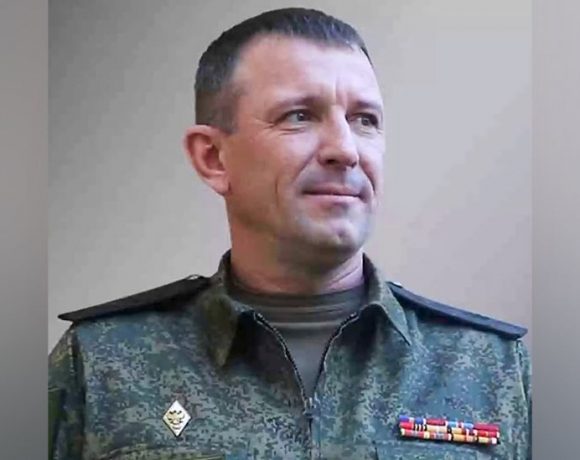
Maj Gen Ivan Popov, the former commander of the 58th Army in southern Zaporizhzhia region, has voiced concerns about the high casualty rate and lack of artillery support in a leaked voice message. He stated that he felt obligated to address these problems honestly rather than remain silent. He criticized senior commanders and accused them of treason, claiming that they demanded his dismissal, which was ultimately approved by Russian Defense Minister Sergei Shoigu. Russian military bloggers suggested that Gen Valery Gerasimov, the head of Russia’s armed forces, ordered Popov’s dismissal due to his alleged “alarmism and blackmailing senior management” when he advocated for the rotation of frontline soldiers who had suffered significant losses.

Popov expressed disappointment with his dismissal, stating that while the Ukrainian army failed to break through their front lines, the senior leadership betrayed their own forces by removing him. The Russian Defense Ministry has not yet commented on the situation. However, a senior official from the United Russia party criticized Andrei Gurulyov, the Russian MP who leaked the voice message, for turning it into a political spectacle. The official stated that Popov’s remarks were meant for closed chats among army commanders and troops. Despite this, the official praised Popov’s integrity and expressed pride in commanders like him.

Zaporizhzhia and the eastern Donetsk region have been the focal points of Ukraine’s counteroffensive, but they have encountered difficulties in breaching well-established Russian defensive lines. Another Russian MP mentioned that Gen Sergei Surovikin, a former commander who had not been seen in public since the Wagner mutiny, was “resting.” There is no official confirmation or comment on his current whereabouts. Additionally, reports emerged of the alleged death of Lt Gen Oleg Tsokov, although Russia’s defense ministry has not officially confirmed it. Tsokov was reportedly killed in a strike in Ukraine’s occupied south coast.

Picture Courtesy: Google/images are subject to copyright
News Trending War

According to Russian officials and military bloggers, Ukraine’s military has launched attacks on occupying Russian forces in the strategically important southern Zaporizhzhia region.

Ukrainian troops, supported by tanks, artillery, and drones, are reportedly attempting to advance south of the town of Orikhiv for the second consecutive night. The counter-offensive is believed to be focused on regaining access to the Sea of Azov, which would weaken Russia’s combat capability and eliminate a land bridge to Crimea, which was annexed by Russia in 2014.

Ukraine has been planning this counter-offensive for months and has been training troops while seeking advanced military equipment from Western allies.

The government has not revealed many details about its plans, but Ukrainian forces are reportedly testing Russian positions along the front line to identify weaknesses.

Picture Courtesy: Google/images are subject to copyright
News Trending War

According to Ukraine, Russia has been accused of detonating the dam. The reasoning behind this accusation is that Russia may have feared Ukraine’s potential use of the dam to facilitate troop movements in their recent counter-offensive.

The destruction of the dam is expected to have several consequences. One significant impact is on a crucial water channel that carries water from the Dnipro River to Crimea, which is currently under Russian occupation. The channel originates from Nova Khakovka and is likely to be affected by the dam’s destruction. Additionally, the Zaporizhzhia nuclear power station, located approximately 160km upstream on the banks of the Dnipro, is also at risk.

Andryi Yermak, the head of President Zelensky’s office, stated that Russia would bear responsibility for depriving the people of Crimea of drinking water. Yermak further emphasized that Russia’s actions pose a threat to the Zaporizhzhia nuclear power plant (ZNPP).

Picture Courtesy: Google/images are subject to copyright
News Trending War

According to rescue officials, a newborn baby has been killed in a Russian missile attack on a maternity centre in southern Ukraine’s Zaporizhzhia area. A doctor and the baby’s mother, who was the only woman in the building at the time, were extricated from the wreckage.

Volodymyr Zelensky, the president of Ukraine, charged that Russia had brought “horror and bloodshed” to his nation. An important nuclear reactor is located in the Zaporizhzhia region, which has been the target of numerous Russian strikes.

The hospital’s maternity wing was hit by Russian missiles overnight, according to Ukrainian emergency services, in the town of Vilnyansk, which is still under Ukrainian control. Although Ukraine controls the territory, the entire Zaporizhzhia region has been annexed by Russia as a result of phoney referendums held in September.

Earlier on Wednesday, Kupiansk, a town in the Kharkiv region that was retaken by Ukrainian forces in September, was the target of bombardment that resulted in the deaths of two civilians, according to Ukrainian officials.

President Zelensky accused Russia of trying to “accomplish with violence and murder what it was unable to do for nine months” on the battlefield in remarks made following both attacks.

Throughout the nine-month conflict, Russia has attacked a number of hospitals, including one in Mariupol that resulted in the deaths of three people, including a toddler, in March. At the time, Russia claimed that the strike had been faked.

The World Health Organization has documented 703 attacks on health infrastructure since Russia’s invasion began on 24 February – it defines an attack as involving violence as well as threatened violence against hospitals, ambulances and medical supplies.

Russian commanders were probably use unmanned aerial vehicles (UAV) built in Iran, the UK Ministry of Defence claimed on Wednesday, to “prioritise medical facilities as targets of opportunity and hit them with guided missiles if found.”

Russia has taken control of several areas of the larger Zaporizhzhia region, including the nuclear power facility, which was seized by Russian forces weeks after the invasion started. Zaporizhzhia and other Ukrainian territory were acquired by Russia in September, although they were repelled on the battlefield in the south, particularly in the Kherson region. Across the Dnipro River, the two armies are facing one another.

Picture Courtesy: Google/images are subject to copyright