
featured News Trending

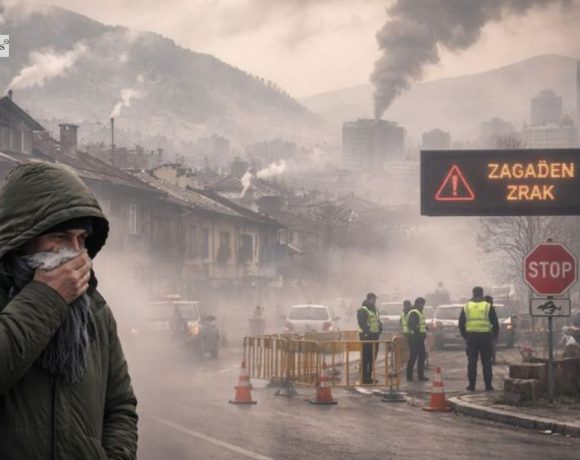
Sarajevo authorities issued an air quality warning and introduced emergency restrictions after the Bosnian capital was ranked the world’s most polluted city on two consecutive evenings by Swiss air quality monitor IQAir. The move came as hazardous air conditions gripped the city of around 350,000 people, following days of dense fog and smog. Officials said pollution levels had risen sharply, prompting immediate intervention to protect public health.

The cantonal government banned trucks weighing over 3.5 tonnes and vehicles that fail to meet European Union emissions standards from entering the city, while also suspending construction work in open areas and prohibiting outdoor public gatherings. Experts say pollution in Sarajevo is largely driven by winter heating, with around 40,000 households relying on firewood and coal, as well as heavy traffic, with nearly 180,000 registered vehicles in the city.

Sarajevo’s location in a valley surrounded by mountains worsens the problem due to temperature inversion, which traps cold air and pollutants near the ground for days. Bosnia ranks among Europe’s worst countries for fine particulate matter (PM2.5) pollution, which the World Bank links to thousands of premature deaths annually and significant economic losses. Health experts warn that prolonged exposure increases the risk of lung cancer and poses serious dangers to vulnerable groups, including children, pregnant women and the elderly.

Pic courtesy: google/ images are subject to copyright
featured News Trending

On Friday, four Balkan countries—Albania, Bosnia, Montenegro, and significant parts of the Croatian coast—experienced simultaneous power outages lasting several hours amid a summer heatwave. The blackouts, which began at 13:00 local time (11:00 GMT), were triggered by a surge in power demand as residents used air conditioning to cope with the high temperatures, which approached 40°C.

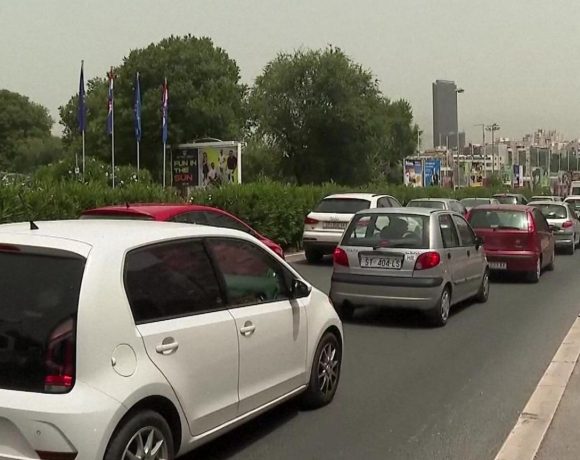
In Bosnia and Croatia, the outages disrupted traffic lights, leading to transportation chaos in major cities such as Sarajevo and Split. Montenegro’s capital, Podgorica, saw even water pumps cease operation. Power suppliers managed to largely restore electricity by the evening but were still investigating the cause of the failure within the interconnected power systems of the four nations.

The power loss affected Croatia’s tourism sector, with Dubrovnik’s restaurants, pubs, and supermarkets closing and leaving tourists in disarray. Montenegro’s Energy Minister, Sasa Mujovic, attributed the blackouts to a sudden spike in power consumption due to the heat. Reports from Montenegro’s Vijesti TV mentioned a fire in a power transmission line near the Bosnian border, though its connection to the blackouts was unclear.

In Albania, power was restored within half an hour, but officials warned of a high risk of further outages due to continued high energy usage. The western Balkans are transitioning from coal-based energy production, a major source of greenhouse gas emissions, to solar energy. However, industry officials indicate that the aging power infrastructure is not yet fully equipped to handle this shift.

Picture Courtesy: Google/images are subject to copyright