
featured News Trending

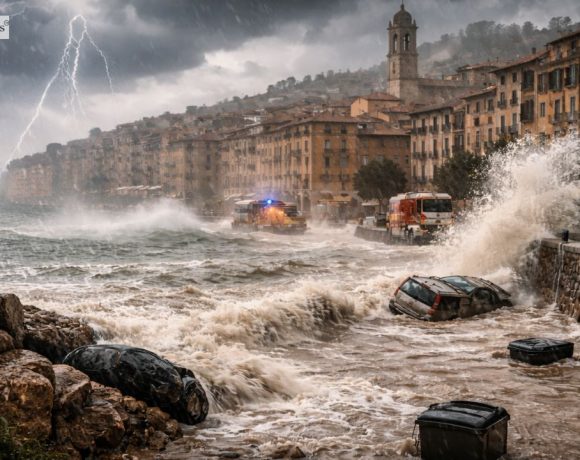
Spain and Portugal remained on high alert as heavy rain and powerful winds swept across the Iberian Peninsula, causing widespread disruption. Trees were uprooted, transport services were interrupted and schools were closed in several regions. In northeastern Spain’s Catalonia region, one person was left in serious condition after being struck by a falling tree, with at least four others reported injured.

Spain issued its highest red weather alert in Galicia, Cantabria and the Basque Country following the arrival of Storm Nils — the eighth storm to hit the country this year. Authorities in Catalonia suspended classes, sporting events and some non-essential healthcare services as wind gusts exceeded 105 km/h, disrupting road and rail networks. Around 40 flights at Barcelona’s El Prat airport were cancelled, while warnings were issued about waves reaching up to nine metres along parts of the coast.

In Portugal, an “atmospheric river” brought intense rainfall, particularly in northern areas, prompting the evacuation of about 3,000 residents. A section of the A1 motorway near Coimbra collapsed after flooding weakened its foundations, and officials said repairs could take weeks. While Storm Oriana is not expected to directly strike mainland Portugal, authorities warned of continued heavy rain and strong winds in the coming days.

Pic courtesy: google/ images are subject to copyright
News Trending

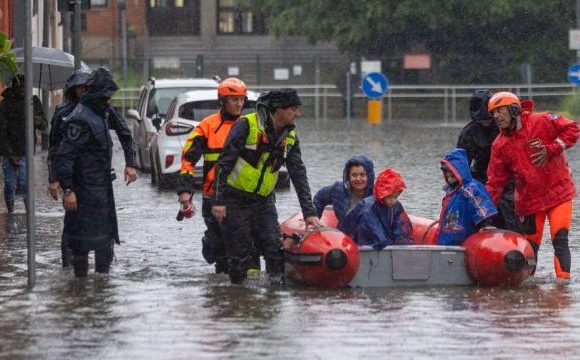
Storms and heavy rainfall have caused significant flooding in northern Italy, with cities like Padua and Vicenza heavily affected. Emergency services have been using dinghies to rescue residents, and footage shows cars floating in the streets. The governor of the Veneto region described the severe weather as a “water bomb.” In contrast, southern Italy, including Sicily, is experiencing an unusual heat wave with temperatures reaching up to 35°C.

Professor Marco Marani from the University of Padua, an expert on climate change, told Corriere del Veneto that extreme weather events are becoming more frequent due to global warming. In Padua, the banks of the Muson dei Sassi river collapsed, causing severe flooding. In Borgo Mantovano, Lombardy, a freight train was overturned by gusts up to 200 km/h. Milan saw 130 mm of rain in one day, leading to flash floods, the most intense May rainfall in over 170 years.

The Veneto region declared a state of red alert, particularly between Vicenza and Verona, where 70 mm of rain fell in 30 minutes, causing water basins to overflow. One person is missing in Como after a bridge collapse.

In the south, Sardinia is experiencing dry conditions, adversely affecting wheat harvests, and water restrictions are expected later in the summer. Prof. Marani emphasized the scientific evidence linking increased frequency of extreme weather events to climate change, underscoring the need to revise water defense calculations and manage climate change effectively.

A recent State of the Climate report by the EU climate agency Copernicus and the World Meteorological Organization highlighted the urgency of climate action and improved flood defenses, noting that in 2023, one-third of European rivers breached high flood thresholds, with 16% surpassing severe levels.

Picture Courtesy: Google/images are subject to copyright