featured News Trending

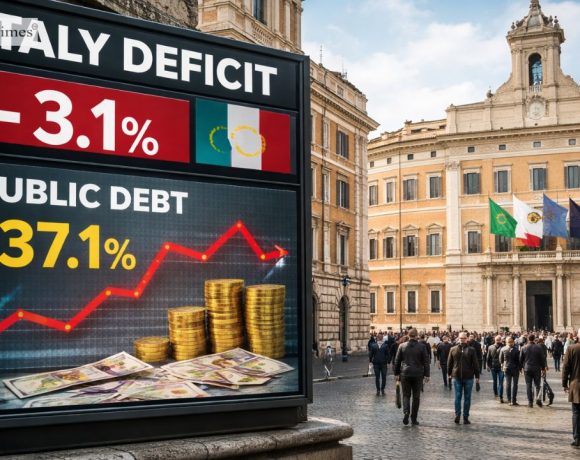
Italy’s 2025 budget deficit came in at 3.1% of GDP, slightly above the European Union’s 3% ceiling, according to ISTAT. While lower than 2024’s 3.4%, the miss casts doubt on Rome’s plan to exit the EU’s Excessive Deficit Procedure early, which could have eased spending constraints ahead of the 2027 elections.

The eurozone’s third-largest economy grew by 0.5% in 2025, matching the government’s revised forecasts, though growth remains below 1% for the fourth consecutive year despite EU recovery funds. The 2026 deficit is targeted at 2.8%, with the government hoping for modest improvement amid lingering fiscal challenges.

Italy’s public debt also exceeded expectations, rising to 137.1% of GDP from 134.7% in 2024, above the government’s 136.2% target. With debt levels remaining the second-highest in the eurozone after Greece, the Meloni administration faces mounting pressure to control spending while promoting economic growth.

Pic courtesy: google/ images are subject to copyright

featured News Trending

An artificial intelligence-driven productivity surge could ease pressure on debt-laden advanced economies, but economists caution it will not solve deep-rooted fiscal challenges. With public debt already exceeding 100% of GDP across most wealthy nations and projected to climb further due to ageing populations, defence spending and climate costs, AI-fuelled growth may only buy governments time rather than repair strained public finances.

Early estimates shared by the Organisation for Economic Co-operation and Development suggest that stronger productivity and employment gains from AI could reduce debt levels across member economies by about 10 percentage points from projected levels by 2036. In the United States, some economists see debt rising more slowly — to around 120% of GDP over the next decade — if AI meaningfully lifts growth and tax revenues. However, ratings agency S&P Global Ratings is not yet factoring in a major improvement in public finances.

Demographics remain the biggest constraint. Ageing populations and entitlement spending continue to drive debt higher, and uncertainty surrounds whether AI-led gains will translate into higher wages, employment and tax revenues. Economists warn that without fiscal discipline, even a sustained productivity boom may not offset mounting borrowing costs or prevent market pressure if growth disappoints.

Pic courtesy: google/ images are subject to copyright

News Trending

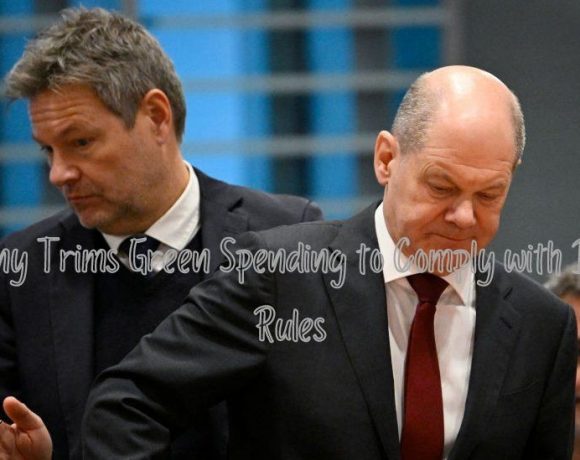
German Chancellor Olaf Scholz has announced that his coalition reached an agreement on the budget following a month of crisis talks. The decision comes after Germany’s constitutional court declared next year’s budget illegal for violating laws on new borrowing. The government plans to adhere to low deficit commitments by cutting certain green subsidies, including ending solar energy and electric car subsidies earlier than initially planned.

Last month, the constitutional court ruled that the 2024 budget violated a clause prohibiting Germany from running a deficit exceeding 0.35% of GDP. Although the deficit was a small portion of total spending, around €17bn or 3.8% of the €450bn budget, negotiations to address the gap were challenging. The coalition parties disagreed on whether to cut spending or suspend debt rules for the fifth consecutive year.

Ultimately, the coalition agreed to reduce subsidies for green energy, construction, and transportation spending. Chancellor Scholz emphasized that the government remains committed to its environmental goals but acknowledged the need to achieve them with reduced funding. The cuts will accelerate the phase-out of subsidies for electric car purchases and solar energy infrastructure, as well as change the funding structure for Germany’s railways.

Reduced spending on the electrical grid will lead to higher electricity costs for consumers. However, approximately €3bn in subsidies to polluting industries will be cut, and the carbon emission prices for companies will increase, partially offsetting the environmental cutbacks.

While the German government, a major supporter of Ukraine in Europe, assured that support for Ukraine would remain unaffected, it will send about €8bn in aid next year. All three coalition parties claimed victories in the spending agreement, with the Social Democrats limiting cuts to the welfare state, the Free Democrats preventing new borrowing, and the Greens asserting that core environmental aims are maintained despite some rolled-back schemes.

Germany’s political culture strongly opposes debt and deficits, with an aversion to high spending. However, some economists argue that this aversion has resulted in persistent underinvestment in crucial infrastructure. Despite this, Germany has one of the lowest public debts among major developed countries.

Picture Courtesy: Google/images are subject to copyright