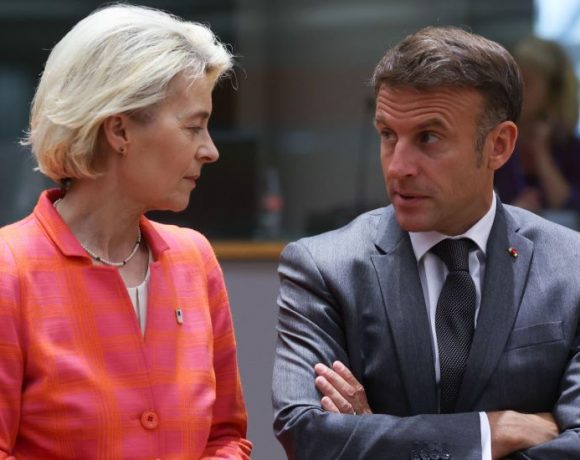
EU leaders have nominated Ursula von der Leyen, the current European Commission head, for a second five-year term during a summit in Brussels. Estonian Prime Minister Kaja Kallas has been selected as the EU’s next foreign affairs chief, and former Portuguese Prime Minister António Costa has been chosen as the next chairman of EU summits. All three candidates are from centrist, pro-EU factions.
The European Parliament will vote on the nominations of Ms. von der Leyen and Ms. Kallas. Von der Leyen is from Germany’s centre-right, Costa is a socialist, and Kallas is a liberal. This leadership package represents continuity for the EU amid geopolitical uncertainty, despite a recent surge in support for hard-right parties in the European Parliament elections.
Italy’s Prime Minister Giorgia Meloni has shown resistance, stating that the plans ignore the successes of hard-right parties like her own. Meloni, who heads the right-wing European Conservatives and Reformists (ECR) bloc, abstained from voting for von der Leyen and voted against Costa and Kallas. Despite the ECR becoming the third largest group in the European Parliament, Meloni was not included in the nomination discussions.
Meloni expressed frustration, arguing that European voters had asked for a different direction. Without naming names, she criticized those who believe in oligarchy as the only acceptable form of democracy.
Von der Leyen will need 361 votes from the European Parliament for confirmation. Support from the centre-right European People’s Party, liberals, and social democrats could give her enough backing, but it will be close. Diplomats suggest that von der Leyen might seek Meloni’s support by offering Italy a powerful commission post.
Von der Leyen expressed gratitude for her nomination and highlighted the importance of supporting Ukraine in its conflict with Russia, a task that may become more complex if Donald Trump wins the upcoming US presidential election.
Kallas, known for her strong support of Ukraine and criticism of the Kremlin, acknowledged the significant responsibility of her new role. Some critics are concerned that her firm stance on Russia could pose challenges.
Costa praised his colleagues and emphasized the importance of European unity and resilience. He will replace Belgium’s Charles Michel, and Kallas will succeed Spain’s Josep Borrell.
Picture Courtesy: Google/images are subject to copyright