News Trending

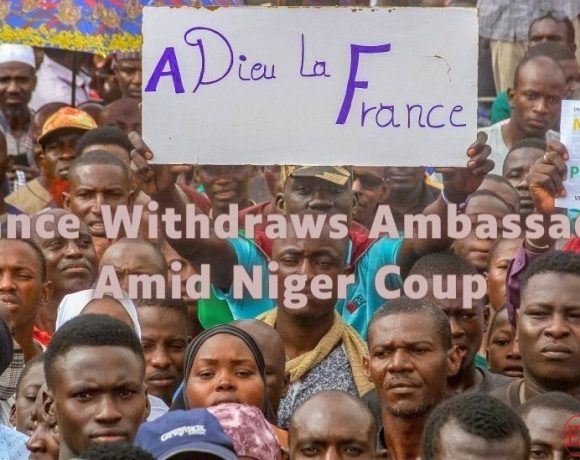
French President Emmanuel Macron has announced the withdrawal of France’s ambassador from Niger and the termination of all military cooperation with the country in response to a recent coup. Macron stated, “France has decided to withdraw its ambassador. In the next hours, our ambassador and several diplomats will return to France,” and he declared that military cooperation is “over,” with French troops set to leave in the coming months. The military junta, which took control of Niger in July, welcomed this decision as a step toward the country’s sovereignty.

Approximately 1,500 French soldiers are stationed in the landlocked West African nation. The move comes after months of tension and protests against France’s presence in Niger, marked by regular demonstrations in the capital, Niamey. This decision has significant implications for France’s operations against Islamist militants in the broader Sahel region and its influence in the area. However, Macron emphasized that France would not allow itself to be held hostage by the coup leaders.

Macron reiterated his support for ousted Niger President Mohamed Bazoum, currently held captive by the coup leaders, viewing him as the country’s “sole legitimate authority.” He described Bazoum as a “hostage” and suggested that the coup was motivated by his courageous reforms and political rivalries.

Niger is one of several former French colonies in West Africa where the military has recently seized power, following similar events in Burkina Faso, Guinea, Mali, and Chad. Anti-French sentiment has been on the rise in the region, with accusations of neocolonialist policies against Paris.

Furthermore, concerns have emerged in the West regarding the growing influence of Russia’s Wagner mercenary group in the Sahel region. Wagner is accused of human rights abuses and has supported some of the new military regimes.

The regional Economic Community of West African States (Ecowas), with France’s support, has threatened military intervention in Niger to restore President Bazoum to power, but no action has been taken thus far.

Niger’s military leaders had previously demanded the departure of French Ambassador Sylvain Itte, but the French government refused to comply and did not recognize the military regime as legitimate. This announcement from Macron comes shortly after Niger’s coup leaders banned “French aircraft” from flying over the country, restricting access to Niger’s airspace for French flights.

Picture Courtesy: Google/images are subject to copyright
News Trending

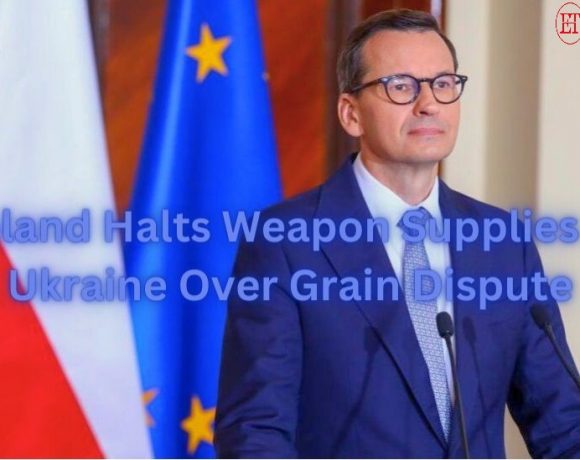
One of Ukraine’s steadfast supporters, Poland, has declared that it will cease its weapon supplies to its neighboring country, Ukraine, citing a diplomatic dispute regarding Ukraine’s grain exports as the primary reason. Prime Minister Mateusz Morawiecki emphasized that Poland’s current focus is on bolstering its own defense capabilities with more modern weaponry.

Poland had already provided Ukraine with significant military assistance, including 320 Soviet-era tanks and 14 MiG-29 fighter jets. However, their willingness to continue such support has dwindled, coinciding with escalating tensions between the two nations.

The recent diplomatic rift was triggered when Poland, along with Hungary and Slovakia, extended a ban on Ukrainian grain imports. Ukrainian President Volodymyr Zelensky’s comments at the United Nations, characterizing their actions as political theater, added fuel to the fire. Poland viewed these remarks as unjustified, given their longstanding support for Ukraine.

In his interview, Prime Minister Morawiecki underlined that while Poland remains committed to assisting Ukraine in its struggle against Russian aggression, it could not allow its own markets to be destabilized by Ukrainian grain imports. He pointed out that Poland was already replacing its depleted military hardware, which had been significantly reduced through transfers to Ukraine, with modern Western-produced equipment.

While arms exports to Ukraine will not cease entirely, only previously agreed deliveries of ammunition and armaments, including those from existing contracts with Ukraine, will be fulfilled. This decision reflects Poland’s commitment to its own security and stability, while the future of its assistance to Ukraine remains uncertain.

The ongoing grain dispute arises from Ukraine’s need to find alternative overland routes for grain exports due to Russia’s full-scale invasion, which nearly closed the main Black Sea shipping lanes. Consequently, large quantities of grain flowed into Central Europe, leading the European Union to temporarily ban grain imports into several countries. Despite the EU lifting the ban, Poland, Hungary, and Slovakia have maintained it, leading to Ukraine’s WTO lawsuits against these nations. Poland has signaled its intention to uphold the ban, while also hinting at the possibility of expanding the list of banned products should Ukraine escalate the grain dispute. However, diplomatic channels remain open, with discussions ongoing to seek a mutually beneficial solution.

Picture Courtesy: Google/images are subject to copyright
News Trending

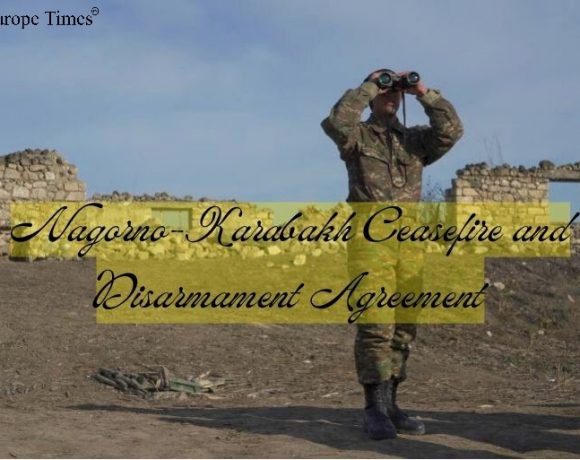
A day after Azerbaijan initiated an offensive in Nagorno-Karabakh, ethnic-Armenian forces have agreed to a ceasefire brokered by Russia. This agreement includes the significant concession of complete disarmament by Karabakh forces. Nagorno-Karabakh, home to around 120,000 ethnic Armenians, is internationally recognized as part of Azerbaijan.

Three years ago, Azerbaijan reclaimed areas in and around Karabakh and, on Tuesday, demanded an unconditional surrender. Karabakh authorities have reported at least 32 casualties, including seven civilians, and approximately 200 injuries since Azerbaijan launched what it termed “anti-terror” operations.

Azerbaijan’s leadership has announced plans to meet with Armenian representatives from Karabakh to discuss “re-integration” matters in the Azerbaijani town of Yevlakh, located about 100 kilometers (60 miles) north of Karabakh’s regional capital, known as Khankendi to Azerbaijanis and Stepanakert to Armenians.

Mediated by Russian peacekeepers, enclave leaders have confirmed a comprehensive cessation of hostilities beginning at 13:00 local time (09:00 GMT). However, despite the ceasefire, loud explosions persisted in the regional capital, and minor clashes were reported by both sides. Azerbaijan claimed to have captured over 90 positions from ethnic Armenians since the conflict began.

Karabakh officials urged residents to remain in shelters and avoid heading to the local airport, which adjoins a Russian peacekeeping base. Nonetheless, a group of civilians gathered near the airport.

Russia revealed that its peacekeepers had evacuated 2,000 people from Karabakh villages since the offensive commenced. Armenian Prime Minister Nikol Pashinyan emphasized that his government played no part in crafting the ceasefire text and insisted that Russian peacekeepers bore full responsibility for the safety of the local population. On Tuesday, he accused Azerbaijan of carrying out “ethnic cleansing” in Karabakh.

The terms of the truce require complete disarmament and disbandment of local Karabakh forces, along with a commitment for Armenian forces to withdraw, despite Yerevan’s denial of any military presence there.

Azerbaijan’s presidential envoy, Elchin Amirbekov, stated that Russian peacekeepers played a crucial role in facilitating the ceasefire’s implementation.

Picture Courtesy: Google/images are subject to copyright
News Trending

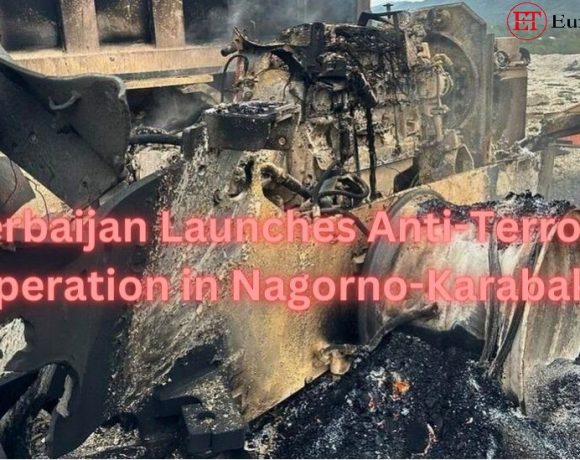
Azerbaijan’s defense ministry has initiated “anti-terrorist” operations in regions of Nagorno-Karabakh controlled by Armenia. Tensions have remained elevated for several months concerning the disputed ethnic-Armenian enclave, which is internationally recognized as part of Azerbaijan.

In Karabakh’s main city, air raid sirens and mortar fire were heard. Tragically, eleven Azerbaijani police and civilians lost their lives in a mine explosion and another incident.

Officials from the breakaway region of Karabakh stated that the Azerbaijani military breached the ceasefire by launching missile and artillery attacks along the entire line of contact. Representatives from Karabakh described it as a “large-scale military offensive.”

Azerbaijan and Armenia, neighboring nations, have previously engaged in two conflicts over Nagorno-Karabakh: first in the early 1990s after the collapse of the Soviet Union and again in 2020. Three years ago, Azerbaijan successfully regained territories surrounding Karabakh, which had been held by Armenia since 1994.

Since December, Azerbaijan has imposed an effective blockade on the only route into the enclave from Armenia, known as the Lachin Corridor.

On Tuesday, Baku’s defense ministry accused Armenian forces of “systematically shelling” its military positions and claimed to have responded by launching “local, anti-terrorist activities” aimed at disarming and securing the withdrawal of Armenian armed forces from Azerbaijani territories. They emphasized that their targets were strictly military and not civilians or civilian infrastructure.

Armenia’s defense ministry denied claims of Armenian military fire, stating that they did not correspond to reality.

The sounds of artillery and gunfire were reported from Khankendi, the regional capital of Karabakh, known as Stepanakert to Armenians. An estimated 120,000 ethnic Armenians reside in this mountainous enclave.

Journalist Siranush Sargsyan reported that residential areas of the city had been struck, including a neighboring building.

Armenian officials noted that, as of 14:00 (10:00 GMT), the situation along Armenia’s own borders was “relatively stable.”

Russia’s foreign ministry disclosed that it had been informed of the Azerbaijani offensive only moments before it occurred, urging both nations to respect the ceasefire that was signed after the 2020 war. The EU’s regional special representative, Toivo Klaar, emphasized the “urgent need for an immediate ceasefire.”

The fragile truce that ended the six-week war in 2020 had been under increasing strain in recent months. Approximately 3,000 Russian peacekeepers were deployed to monitor the ceasefire, but Russia’s attention has been redirected to its full-scale invasion of Ukraine. Armenian Prime Minister Nikol Pashinyan recently stated that Russia was “spontaneously leaving the region.”

Azerbaijan had denied increasing troop numbers in the region. On Monday, it permitted aid from the International Committee of the Red Cross to enter Karabakh via two routes, one through the Lachin Corridor from Armenia and the other on Azerbaijan’s Aghdam road.

Hopes for tensions to ease were dashed when Azerbaijani officials reported six casualties, including four police officers, in an incident where their vehicle hit a landmine in the Khojavand area, which had been retaken during the 2020 war. Meanwhile, ethnic Armenian officials in Karabakh asserted that it was Azerbaijan’s military that had violated the ceasefire.

Picture Courtesy: Google/images are subject to copyright
News Trending

In response to a series of Quran burnings that sparked outrage in Muslim countries, the Danish government has introduced a proposal to prohibit the public burning of religious texts, including the Quran. Justice Minister Peter Hummelgaard emphasized that such acts not only harmed Denmark’s reputation but also posed a risk to its citizens’ safety. The new legislation aims to classify improper treatment of the Quran or Bible as a criminal offense, carrying penalties of fines and potential imprisonment for up to two years.

The Danish government, which holds a center-right stance, aims to convey a message to the international community through this move. Foreign Minister Lars Lokke Rasmussen highlighted that recent weeks have witnessed around 170 demonstrations, some involving the burning of Quran copies near foreign embassies. Denmark’s intelligence agency, PET, has cautioned that these incidents have escalated the terrorist threat.

Denmark’s neighboring country, Sweden, has also experienced similar Quran burnings, leading to concerns about worsening security. However, both Denmark and Sweden had been cautious in their response due to their strong tradition of freedom of expression. Sweden abolished its blasphemy laws in the 1970s.

Denmark’s decision to address this issue gained momentum after further Quran burnings occurred in both countries in July. The Organisation of Islamic Cooperation (OIC) urged its member nations to take appropriate action against countries where such desecration occurred.

The Danish justice minister clarified that the proposed change in the law wasn’t directed at verbal, written, or satirical expressions. Rather, the focus was on curbing actions that only fueled division and hatred. Deputy Prime Minister Jakob Ellemann-Jensen stressed the importance of responsible behavior even while exercising freedom of expression.

Denmark acknowledged that it couldn’t ignore the negative implications of these actions on its security. Meanwhile, Sweden’s Prime Minister, Ulf Kristersson, noted that his country wouldn’t follow Denmark’s approach, citing the need for potential constitutional amendments.

The Danish government plans to present the proposed legal changes on September 1st, with the aim of passing them in parliament by year-end. The prohibition is expected to be included within a section of the criminal code that addresses public insults toward foreign states, flags, or symbols.

Picture Courtesy: Google/images are subject to copyright
News Trending

In Sweden, a Kurdish man has been sentenced to four-and-a-half years in prison for various crimes, including an attempt to finance terrorism. This is the first instance where Sweden’s updated anti-terrorism laws have been utilized in a case involving the Kurdish militant group PKK. Turkey has long urged Sweden to take action against Kurdish separatists. Sweden’s aspirations to join NATO have been delayed, primarily due to Turkey’s demand for the extradition of individuals it considers terrorists.

Ahead of a NATO summit, Swedish Prime Minister Ulf Kristersson is set to meet with Turkish President Recep Tayyip Erdogan in Lithuania. Sweden is hopeful for NATO membership and has received support from President Joe Biden. The timing of the court case was emphasized by commentators, who noted that it conveyed a message to Ankara that Sweden was cracking down on the PKK.

The convicted Kurdish man, who has Turkish origins, will be deported after serving his sentence. The judge highlighted that Sweden’s NATO bid did not influence the court’s decision. Last month, Sweden strengthened its anti-terrorism laws to criminalize arranging meetings to provide financial or other assistance to banned groups. Critics raised concerns about potential impacts on freedom of speech.

The sentencing coincided with a significant meeting in Brussels involving the foreign ministers of Sweden, Turkey, and Finland, ahead of the upcoming NATO summit in Vilnius. Finland’s Foreign Minister expressed hopes for a swift announcement regarding Sweden’s NATO membership. Turkey’s President has voiced reservations about Sweden’s bid, emphasizing the need for further action.

Picture Courtesy: Google/images are subject to copyright