

featured News Trending

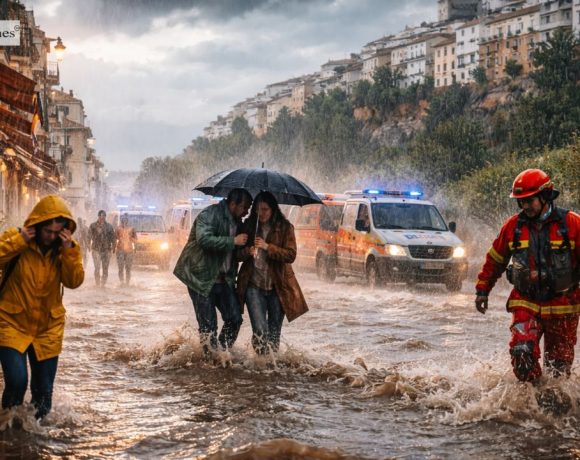
Spain and Portugal remained on high alert as heavy rain and powerful winds swept across the Iberian Peninsula, causing widespread disruption. Trees were uprooted, transport services were interrupted and schools were closed in several regions. In northeastern Spain’s Catalonia region, one person was left in serious condition after being struck by a falling tree, with at least four others reported injured.

Spain issued its highest red weather alert in Galicia, Cantabria and the Basque Country following the arrival of Storm Nils — the eighth storm to hit the country this year. Authorities in Catalonia suspended classes, sporting events and some non-essential healthcare services as wind gusts exceeded 105 km/h, disrupting road and rail networks. Around 40 flights at Barcelona’s El Prat airport were cancelled, while warnings were issued about waves reaching up to nine metres along parts of the coast.

In Portugal, an “atmospheric river” brought intense rainfall, particularly in northern areas, prompting the evacuation of about 3,000 residents. A section of the A1 motorway near Coimbra collapsed after flooding weakened its foundations, and officials said repairs could take weeks. While Storm Oriana is not expected to directly strike mainland Portugal, authorities warned of continued heavy rain and strong winds in the coming days.

Pic courtesy: google/ images are subject to copyright
featured News Trending

Spanish and Portuguese authorities are preparing for the impact of Storm Leo, which has brought torrential rains to the Iberian Peninsula just a week after Storm Kristin caused widespread damage. In southern Spain’s Sierra Grazalema, rainfall is expected to reach levels equivalent to a full year’s precipitation, prompting class suspensions and travel warnings across affected areas.

The storm has raised concerns over flooding, especially as the ground remains saturated from January’s record rainfall. Emergency services in Andalusia have deployed personnel, aircraft, and helicopters to monitor flood-prone zones, stabilize landslide areas, and provide rapid response to evacuations. Around 3,000 residents in high-risk zones such as Grazalema, Campo de Gibraltar, Ronda, and Jaen have already been evacuated.

In Portugal, the national Civil Protection Service has raised its preparedness to the highest level, deploying up to 3,000 armed forces personnel and 42 inflatable boats to protect flood-prone sections of major rivers. Authorities have urged residents to avoid non-essential travel, close day centres, and cancel outdoor activities as the storm progresses.

Pic courtesy: google/ images are subject to copyright
News Trending

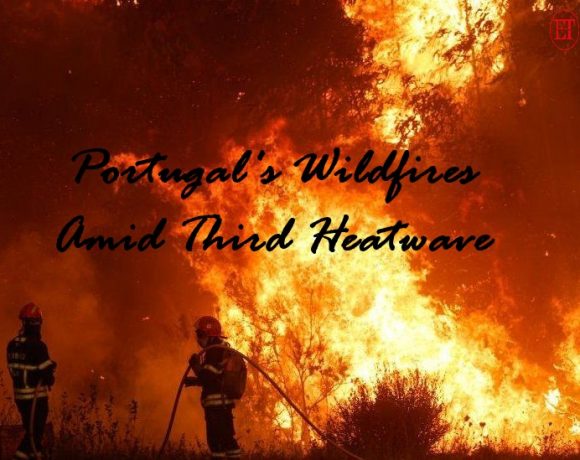
Amidst soaring temperatures, firefighters in Portugal are working diligently to contain wildfires that have spread across thousands of hectares. An overnight effort near Odemira involved around 800 personnel, leading to the evacuation of over 1,400 individuals. Tragically, nine firefighters have sustained injuries during the firefighting operations.

The Iberian Peninsula is expected to experience temperatures exceeding 40°C (104°F) this week. While three significant fires in Spain have been brought under control after scorching extensive areas, weather advisories persist across the country.

Portugal recorded its highest temperature of the year, reaching 46.4°C (116°F) in Santarém on Monday. A blaze that ignited near Odemira on Saturday was propelled southward into the Algarve’s hilly interior due to strong winds. Approximately 6,700 hectares (16,600 acres) of land have already been devastated, and numerous villages, tourist accommodations, and a camping site were evacuated. The mayor of Odemira described the situation as “critical, difficult, and complex.”

Elsewhere in Portugal, major fires prompted the closure of several sections of highways, including parts of the A1 connecting Lisbon and Porto. Firefighting efforts across both regions are being aided by sixteen waterbombing aircraft.

In response to the heightened fire risk, authorities have labeled over 120 municipalities in Portugal as being at maximum wildfire risk. Meanwhile, in Spain, fires near Cadiz, Huelva, and Catalonia consumed over 1,000 hectares (2,470 acres) collectively over the weekend.

This week’s heatwave marks the third to affect the Iberian peninsula this summer. According to Ruben del Campo of Spain’s State Meteorological Agency, the heatwave results from a substantial mass of hot, dry air originating from North Africa and is projected to be more intense, widespread, and longer-lasting than the two previous ones in July.

The increasing risk of such scorching and dry conditions that fuel wildfires is attributed to climate change. Global temperatures have already risen by around 1.1°C since the onset of the industrial era, and this trend will persist unless governments worldwide take significant measures to reduce emissions.

Picture Courtesy: Google/images are subject to copyright