
featured News Trending

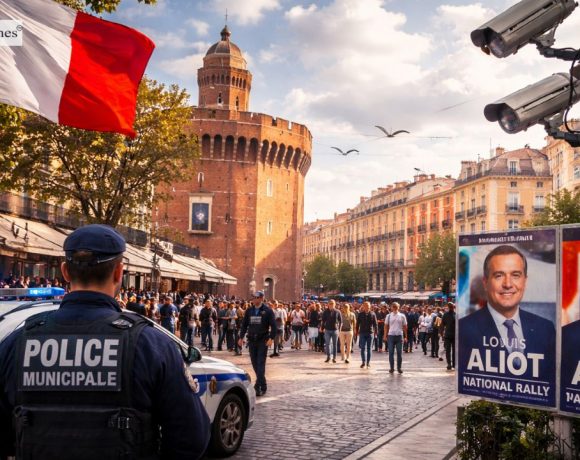
In the southern French city of Perpignan, far-right mayor Louis Aliot is campaigning for another term with a strong focus on law and order. Representing the National Rally, Aliot has made increased policing, surveillance cameras, and stricter enforcement key parts of his administration, presenting the city as a model for how his party would govern elsewhere.

Since taking office in 2020, the municipality has expanded its police force and intensified efforts against drug trafficking, leading to a sharp rise in reported cases and fines. Perpignan now has one of the highest ratios of municipal police per resident among major French cities. Supporters say these measures have improved safety and cleanliness, while critics argue the tougher policing has not solved deeper social and economic problems.

The city has become a symbolic battleground ahead of France’s municipal and future presidential elections, drawing attention from national political figures such as Jordan Bardella and Jean-Luc Mélenchon. Meanwhile, Aliot’s leadership also faces scrutiny over rising municipal debt and a pending court appeal that could affect his political future.

Pic courtesy: google/ images are subject to copyright
featured News Trending

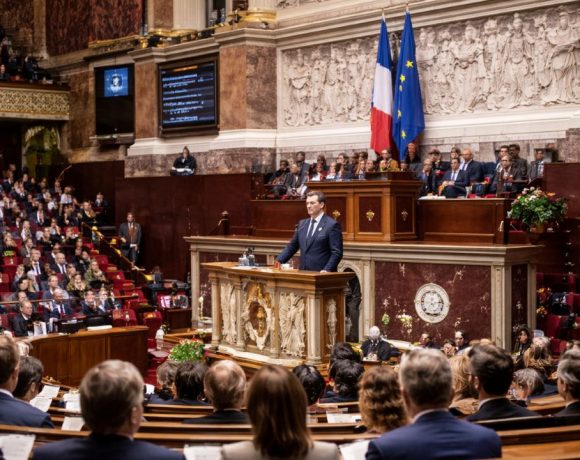
The French government has survived two no-confidence motions in the National Assembly after pushing through a new energy law by decree earlier this month. The motions were filed by the far-right National Rally (RN) and the hard-left La France Insoumise (LFI), but neither secured the 289 votes required to topple the government. The RN-backed motion received 140 votes, while the LFI motion gathered 108, allowing Prime Minister Sebastien Lecornu to remain in office.

The outcome offers temporary relief to Lecornu’s minority administration, which has faced repeated challenges since taking power. Earlier this year, the government also survived two no-confidence votes linked to the passage of a delayed budget. However, political uncertainty persists in France, with President Emmanuel Macron experiencing low approval ratings as he approaches the end of his second term.

The contested energy law outlines a revised national strategy that scales back renewable energy targets and eases operational pressure on state-owned utility Electricite de France (EDF), including reversing a previous mandate to shut down 14 nuclear reactors. The measure sparked intense debate between lawmakers advocating continued renewable subsidies and those favouring investment in nuclear power, amid concerns over the country’s high debt and long-term energy security.

Pic courtesy: google/ images are subject to copyright
featured News Trending

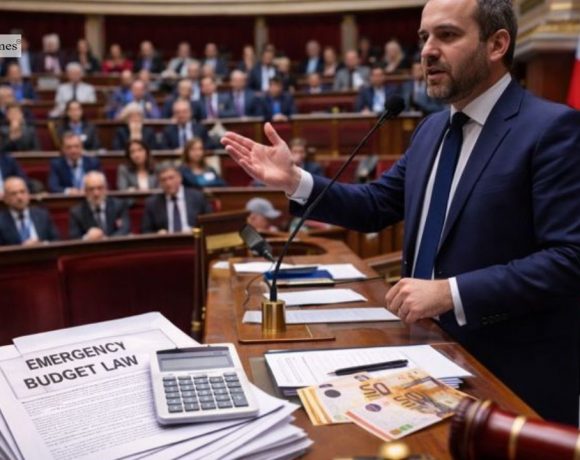
French Prime Minister Sebastien Lecornu has begun urgent talks with political leaders to pass emergency legislation that would keep the French government functioning into the new year, after lawmakers failed to agree on a full 2026 budget. A joint committee from both chambers of parliament was unable to finalise the budget bill last week, forcing the government to seek a temporary rollover law to allow spending, tax collection and borrowing to continue from January.

Lecornu is consulting party leaders, excluding the far right and far left, ahead of a cabinet meeting where the stopgap budget is expected to be approved before being sent to parliament. Lawmakers are widely expected to pass the measure on Tuesday, buying time for further negotiations on a complete 2026 budget in January. France’s fiscal situation is under close scrutiny from investors and credit rating agencies, as it currently has the highest budget deficit in the euro zone.

However, the political situation remains fragile. Lecornu has ruled out using special constitutional powers to force a budget compromise, as doing so could trigger a no-confidence vote. His minority government faces deep divisions in parliament, where budget disputes have already brought down three governments since President Emmanuel Macron lost his majority in the 2024 snap election. Last year, reliance on similar emergency legislation delayed the 2025 budget and cost the state an estimated €12 billion.

Pic courtesy: google/ images are subject to copyright