
featured News Trending

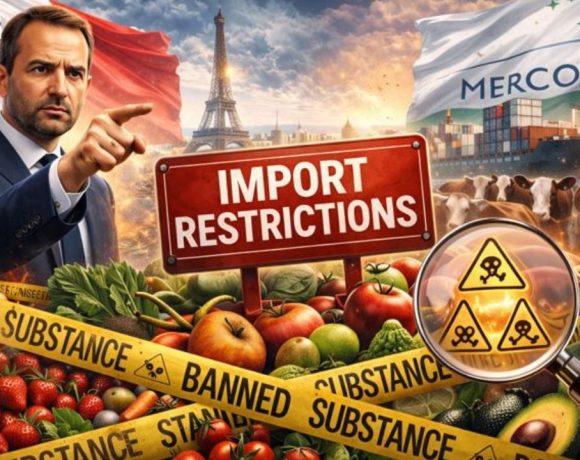
France has announced stricter checks on a range of food imports in response to protests by farmers who argue they face unfair competition from countries with weaker agricultural regulations. The move comes as opposition grows in France to a proposed European Union trade agreement with the South American Mercosur bloc, as well as concerns over livestock disease controls.

Agriculture Minister Annie Genevard said the new measures aim to ensure imported food meets EU standards, particularly regarding the use of banned pesticides and fungicides. France will soon issue a decree suspending imports of products found to contain prohibited substances, including mancozeb, glufosinate, thiophanate-methyl and carbendazim. Fruits and vegetables such as melons, apples, cherries, strawberries, grapes and potatoes will only be sold if they show no traces of these chemicals.

Prime Minister Sebastien Lecornu said any imported product failing to meet these standards would be barred from entering France. While Germany and Spain support the Mercosur deal, critics in France fear it would lead to cheaper imports, especially beef, that do not comply with EU environmental and food safety rules. The government said protecting farmers, public health and fair competition is non-negotiable and urged the European Commission to extend similar rules across the EU.

Pic courtesy: google/ images are subject to copyright
featured News Trending

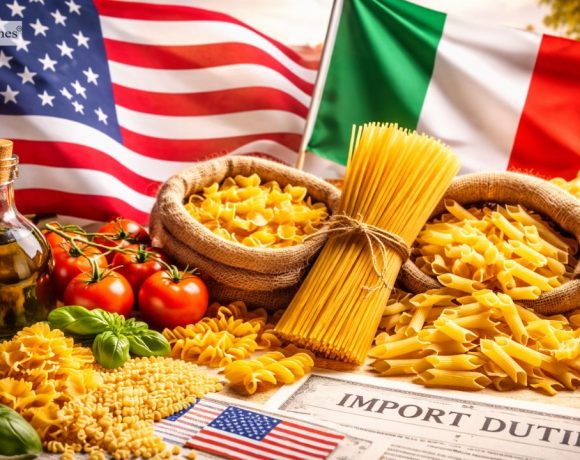
The US government has sharply reduced proposed tariffs on Italian pasta, easing pressure on producers that had faced the prospect of levies as high as 92%. Following a review by the US Department of Commerce, the duties have been cut to a range of between 2% and 14%, offering relief to major brands such as Barilla, La Molisana and Pastificio Lucio Garofalo, which were accused of selling pasta at unfairly low prices.

The revised tariffs will apply in addition to a separate 15% duty imposed on most EU goods imported into the US, although a final decision on the pasta levies has not yet been made. The Department of Commerce said its preliminary analysis showed Italian producers had addressed many of its concerns, with final results and definitive tariff levels due to be announced on March 12.

Italy exports an estimated $770 million worth of pasta to the US each year, with the 13 targeted companies accounting for around 16% of those shipments. Italy’s government and industry groups welcomed the move, warning earlier that steep tariffs would severely damage the sector, while the European Commission said it stood ready to intervene if needed.

Pic courtesy: google/ images are subject to copyright
News Trending

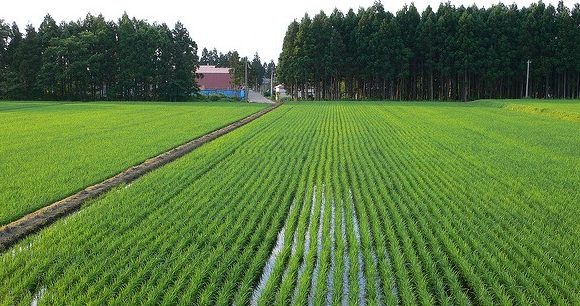
A government spokesperson in Japan has expressed the country’s welcome to the European Union (EU) potentially lifting restrictions on food imports that were imposed after the 2011 nuclear accident caused by an earthquake and tsunami. According to a report in the Nikkei newspaper, the EU is in the final stages of removing all restrictions on Japanese food, although the sources for this information were not disclosed.

The bans on food imports have been in effect since the Fukushima Dai-ichi nuclear plant was damaged by the earthquake and tsunami, resulting in multiple meltdowns. The spokesperson, Mr Hirokazu Matsuno, stated during a Tokyo press conference that the Japanese government appreciates the positive steps toward lifting the restrictions. It is hoped that easing the restrictions will contribute to the reconstruction efforts in the areas devastated by the nuclear disaster.

The 2011 earthquake and tsunami tragically claimed the lives of nearly 20,000 people along Japan’s Pacific coast. The meltdowns at the Fukushima nuclear plant led to the evacuation of tens of thousands of residents.

This news about the potential lifting of restrictions comes just before the visit of Rafael Mariano Grossi, the chief of the International Atomic Energy Agency (IAEA), to Japan. During his visit, Grossi will present the findings of the IAEA’s safety review regarding Japan’s plan to release water from the Fukushima nuclear power plant into the ocean. The Japanese government intends to release 1.3 million metric tons of water that has been exposed to radiation inside the damaged power plant after removing most of its radioactive elements.

The water to be released contains traces of tritium, an isotope that is difficult to remove from water and has primarily been used to cool the damaged reactors. The IAEA plans to establish an office at the Fukushima plant during Grossi’s visit, indicating its ongoing involvement and oversight of the situation.

Picture Courtesy: Google/images are subject to copyright