
featured News Trending

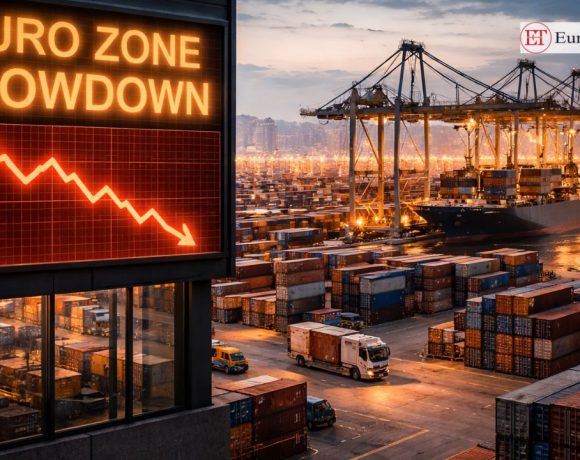
Economic growth across the euro zone slowed sharply in March as rising energy costs and supply chain disruptions weighed on business activity. According to data from S&P Global, the composite Purchasing Managers’ Index (PMI) for the region fell to 50.7 from 51.9 in February, marking its lowest level in nine months, though still marginally indicating expansion.

The slowdown was largely driven by weakening demand, with new business declining for the first time in eight months. Analysts from S&P Global Market Intelligence highlighted that the ongoing Middle East conflict has pushed up energy prices and disrupted supply chains, erasing earlier signs of recovery. Export orders also dropped, with international demand for services seeing its steepest fall in six months.

Business confidence and employment levels weakened, raising concerns about future growth. While countries like Spain showed resilience, major economies such as France and Italy contracted, and Germany’s growth slowed significantly. Rising input costs, now at a three-year high, have forced companies to increase prices, pushing inflation above the European Central Bank target and complicating the balance between controlling inflation and sustaining economic growth.

Pic courtesy: google/ images are subject to copyright

featured News Trending

Germany’s service sector growth lost momentum in March, with business activity slowing sharply due to weakening demand linked to the ongoing Middle East conflict. The latest survey by S&P Global showed that the services Purchasing Managers’ Index (PMI) fell to 50.9 from 53.5 in February, marking its lowest level in seven months, though still slightly above the 50 threshold that indicates growth.

The slowdown has been attributed to rising costs, particularly fuel prices, and increased economic uncertainty. According to analysts at S&P Global Market Intelligence, service providers are struggling to pass on higher costs to customers due to weaker demand. New business inflows declined for the first time since September, highlighting the immediate impact of geopolitical tensions on the sector.

Business confidence has also taken a hit, with expectations dropping to a three-month low. The overall composite PMI, which combines manufacturing and services, slipped to 51.9 in March from 53.2 in February, largely driven by the downturn in services. Analysts warn that elevated energy prices, supply chain disruptions, and ongoing uncertainty could continue to weigh on Germany’s economic growth in the coming months.

Pic courtesy: google/ images are subject to copyright