
featured News Trending

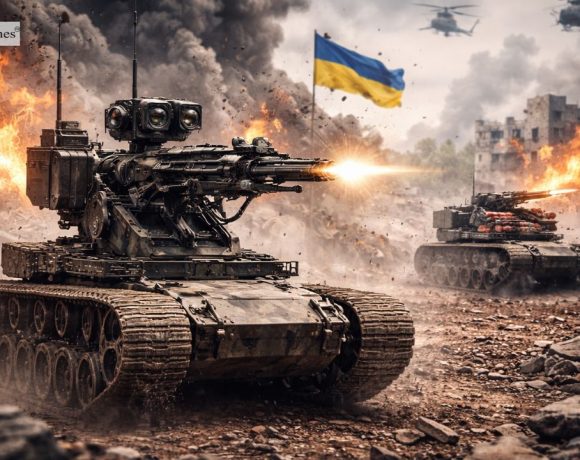
The war in Ukraine is rapidly evolving into a high-tech battlefield, with armed robots playing a growing role in combat operations. Uncrewed ground vehicles (UGVs) are now being deployed by Ukrainian forces to carry out risky tasks such as attacking enemy positions, defending front lines, and even capturing opposing soldiers. Military officials say these robotic systems help reduce risks to human troops in increasingly dangerous combat zones.

Some Ukrainian UGVs are equipped with machine guns, grenade launchers, or explosives and are used in ambushes or kamikaze-style missions against enemy positions. Unlike aerial drones, these ground robots can move quietly across the battlefield, making them difficult to detect. Despite their advanced capabilities, commanders say the final decision to fire remains with human operators controlling the machines remotely to avoid mistakes and protect civilians.

Both Ukraine and Russia are expanding the use of robotic combat systems as the war continues. Ukrainian manufacturers have significantly increased production, with thousands of UGVs already deployed and demand expected to surge further. Experts say future battles could involve swarms of coordinated drones and robots operating across land, air and sea, marking a major shift in the way wars are fought.

Pic courtesy: google/ images are subject to copyright
featured News Trending

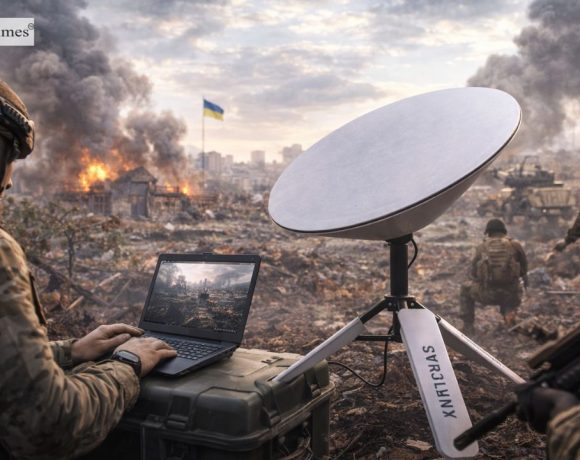
A decision by Elon Musk’s company SpaceX to block Russian forces from accessing its Starlink satellite internet service appears to have disrupted Moscow’s frontline operations in Ukraine. The move, reportedly requested by Ukraine’s defence minister Mykhailo Fedorov, has limited Russian troops’ ability to coordinate drone strikes and battlefield communications. Ukrainian soldiers say the change has reduced assaults and weakened Russia’s offensive capacity, particularly along parts of the southern and eastern front.

Starlink had been widely used by both sides during the four-year war, enabling real-time drone guidance and secure communications. Since the shutdown on 1 February, only terminals approved by Kyiv remain active, forcing Russian units to seek alternative systems. Ukrainian volunteer group InformNapalm claims it identified more than 2,400 Russian-linked terminals through a phishing operation, with several later targeted near the front lines. Ukraine’s Security Service (SBU) has also warned citizens against collaborating in illegal Starlink registrations, calling such actions high treason.

While some Ukrainian troops report little immediate change, others describe improved opportunities to intercept communications and push back Russian forces, especially near contested areas like Pokrovsk. Analysts say the disruption could limit Russia’s ability to conduct long-range drone strikes and hamper coordination, though Moscow insists the impact is minimal. Ukrainian officials believe they have a limited window to exploit the setback before Russian forces adapt, potentially strengthening Kyiv’s position both on the battlefield and in any future negotiations.

Pic courtesy: google/ images are subject to copyright