
Food News Trending

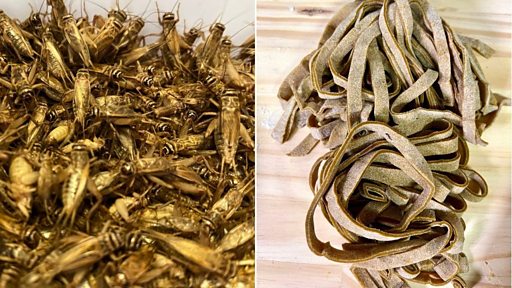
In a small room near the Alps in northern Italy, millions of crickets are being processed to become food despite initial resistance. The crickets are frozen, boiled, dried, and pulverized to create a light brown flour used in various food products such as pasta, bread, energy bars, and even sports drinks. Italy, known for its culinary traditions, has traditionally resisted the idea of eating insects, with the government even taking steps to ban their use in pizza and pasta production. However, several Italian producers have been experimenting with cricket-based pasta, pizza, and snacks.

The shift towards insect consumption in Italy is driven by sustainability concerns. Insect farming requires significantly less water and land compared to traditional livestock farming, making it a more environmentally friendly option. Insects are also rich in vitamins, fiber, minerals, and amino acids, making them a nutritious superfood. However, the main challenge to widespread adoption of insect-based food is the price, as it remains more expensive than traditional alternatives.

In addition to cost, social acceptance plays a role in the resistance to insect food in Italy. The country prides itself on its Mediterranean diet, and some view insect products as a threat to Italian culinary traditions. Concerns about the potential health effects of consuming insects and the fear of deviating from established eating habits contribute to the opposition.

Italy is not the only country divided on the issue of insect food. Poland and other European countries have seen debates and political disputes surrounding the topic. However, countries like Austria, Belgium, and the Netherlands have shown more openness to insect consumption.

As the global population continues to grow, finding sustainable food sources becomes crucial. Insect consumption is seen as a potential solution to meet the rising demand while minimizing the environmental impact. With the recent approval of insect consumption by the EU, the insect food sector is expected to grow, leading to potential price reductions and increased availability.

Producers like Ivan Albano, who runs the Italian Cricket Farm, see insect farming as an environmentally friendly and sustainable practice that could play a role in addressing global food challenges. Despite initial resistance, more people are showing curiosity and ordering cricket-based products, indicating a shifting mindset towards insect consumption. The hope is that as awareness and acceptance increase, insect food will become a viable option to feed the growing population while minimizing ecological impact.

Picture Courtesy: Google/images are subject to copyright

News Trending

A procession of Armenian priests, distinguished by their peaked black headdresses and long robes, marches through the stone streets of Jerusalem’s Old City. Accompanied by suited individuals in felt tarboosh hats, carrying ceremonial walking sticks, they make their way to the Church of the Holy Sepulchre for prayers.

While Jerusalem remains a focal point of the Israeli-Palestinian conflict, the presence of Armenians in the city dates back to the 4th century when Armenia became the first nation to adopt Christianity as its official religion. The Armenian community has a significant stake in the city’s most sacred Christian sites and resides in their own quarter, situated in the southwestern corner of the Old City, where approximately 2,000 Armenians reside.

However, the community now finds itself feeling vulnerable due to a controversial real estate transaction involving their own Church leaders. Amidst vehement protests, the Armenian patriarch has gone into hiding, and a disgraced priest, who denies any wrongdoing, has fled to California.

The unfolding situation reveals that approximately 25% of the Armenian Quarter has been sold on a 99-year lease to an enigmatic Jewish Australian businessman for a luxury development. This includes a substantial car parking area, one of the few remaining open spaces within the Old City walls, which has already been taken over by his company. Many Armenians had hoped this land could be used for the construction of affordable housing for young couples within their dwindling community.

Unofficially obtained plans indicate that the sale encompasses an Ottoman-era building housing five Armenian households, a restaurant, shops, and the seminary. Concerns have been raised that this could jeopardize the long-term viability of living within the quarter.

However, the controversy extends beyond the immediate community. The ramifications are seen as far-reaching, as losing this historically significant land, owned for 700 years, would not only impact the daily cultural life of the Armenians but also alter the overall fabric of Jerusalem. Hagop, a community activist, explains that it would disrupt the status quo and the intricate mosaic that defines the city.

During Orthodox Easter celebrations in April, panic gripped the Armenian community as news of the land sale spread. The Armenian Patriarch, Nourhan Manougian, admitted to signing away the land but claimed he had been deceived by a local priest in his employ.

The defrocked priest faced heated scenes as he was expelled from the Armenian Quarter, escorted away under Israeli police protection while residents labeled him a “traitor.” In recent times, Armenians have been participating in weekly protests, joining arms and singing patriotic songs beneath the window of the patriarch, who now remains secluded within his convent. They demand the revocation of the land deal.

Against the backdrop of increasing attacks on Christians in Jerusalem by extremist Jewish groups, some Armenians view this sale as self-inflicted harm to the Christian presence in the city. Arda, an Old City resident, laments the changing character of the city and asserts that religious nationalists are growing bolder due to the prevailing political climate in Israel.

East Jerusalem, including the Old City, was captured by Israel from Jordan in the 1967 Middle East War and subsequently occupied and annexed, despite lacking international recognition. Since then, it has remained at the center of the Israeli-Palestinian conflict, with both sides claiming it as their capital. Consequently, plots of land in this area are fiercely contested.

Near the Armenian Quarter, at Jaffa Gate, a notable entry point to the Christian Quarter, a reminder of these disputes persists. Two landmark hotels, managed by Palestinians, were covertly sold to foreign companies acting as proxies for a radical Jewish settler group. The Greek Orthodox Church’s lengthy legal battle to annul the deal was unsuccessful, and settlers moved into a portion of one of the hotels last year.

Armenian elders recount that settlers have frequently expressed interest in acquiring land within their quarter to bolster the Jewish presence in East Jerusalem. The proximity of the Armenian Quarter to the Jewish one makes it particularly desirable.

However, a spokesperson for the settler group involved in the Jaffa Gate property purchase claimed ignorance of the Armenian land sale when approached by the BBC.

Picture Courtesy: Google/images are subject to copyright