featured News Trending

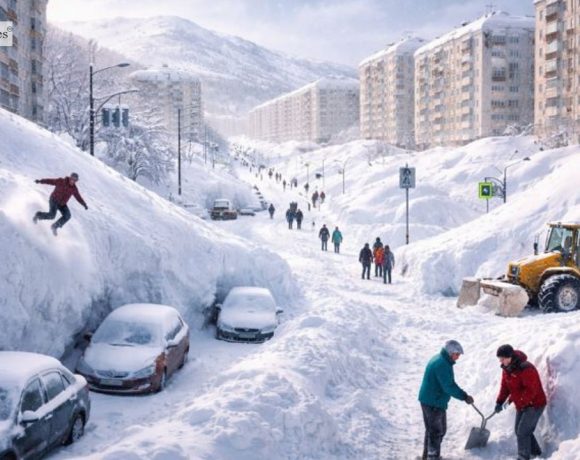
Russia’s Far Eastern Kamchatka Peninsula has been hit by its heaviest snowfall in six decades, leaving cities buried under massive snowdrifts several metres high. In the port city of Petropavlovsk-Kamchatsky, extreme winter storms have blocked building entrances, submerged cars and disrupted daily life, according to visuals and data from weather monitoring stations.

Officials said more than two metres of snow has fallen in the first half of January alone, following 3.7 metres recorded in December. Reuters images showed vehicles almost completely buried, with four-wheel drives struggling to move through thick drifts, while residents were forced to dig narrow paths to access apartment buildings and roads.

Despite the disruption, locals have tried to find moments of humour amid the chaos. Videos on Russian media showed people walking along towering snowbanks beside traffic lights, while some jumped off the drifts for fun. “The car has been parked in a snowdrift for a month,” said local photographer Lydmila Moskvicheva, capturing both the frustration and surreal beauty of the historic snowfall.

Pic courtesy: google/ images are subject to copyright
News Trending

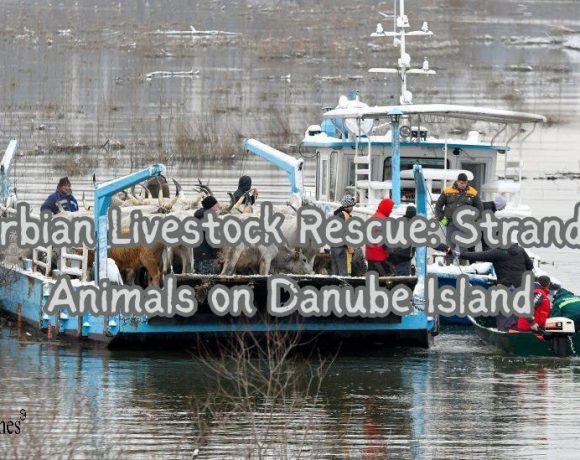
An operation is in progress to rescue around 200 cattle, calves, and horses stranded on Krcedin island in the River Danube, near Belgrade, Serbia. Rising water levels last week prevented the livestock from returning to shore. The evacuation, which began on Tuesday, has saved approximately 60 animals so far. Harsh weather conditions, including freezing temperatures and concerns about starvation, have intensified the urgency of the rescue mission.

Krcedin island, located on the left bank of the Danube, experienced a sudden rise in water levels due to melting snow caused by unseasonably mild weather in late 2023 in the Balkan region. The island is situated 3km from the shore and approximately 50km upstream from Belgrade.

Farmers had been appealing for days to have their livestock rescued as conditions deteriorated. On Tuesday, a rescue team comprising the Serbian military, the emergencies department, the forestry agency, and local citizens used a raft to transfer about 60 animals to safety. However, further attempts faced setbacks, including the replacement of the first raft due to missing railings and the breakdown of its replacement after only two runs.

Environmental group Eko Straza reported that the stranded cattle were exhausted, having lost up to 50kg of their weight. A new boat was hired to continue the rescue on Wednesday. Transporting dozens of wild horses, which are not accustomed to human contact, posed additional challenges.

With freezing conditions and the threat of hunger, speed has become crucial in the evacuation. Cattle breeder Milenko Plavsic expressed concern that some of his animals had already died, and the remaining ones were at risk. He explained that, in a normal year, the animals would return home by wading through shallow waters for 10km, but the high water levels have prevented grazing.

Picture Courtesy: Google/images are subject to copyright