
featured News Trending

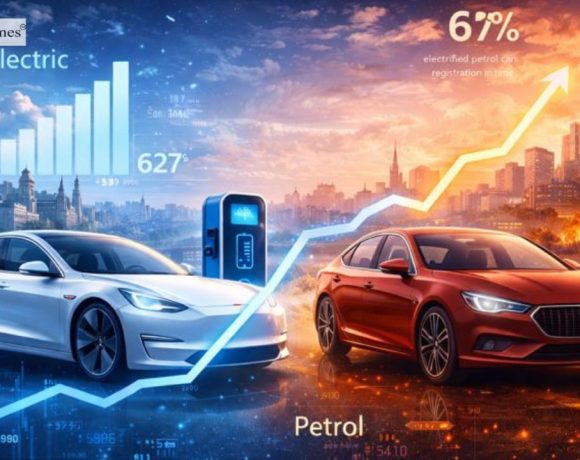
Sales of fully electric cars in the European Union surpassed petrol vehicle sales for the first time in December, according to data from industry body ACEA. Battery-electric vehicle registrations also exceeded petrol sales across the wider European market, including Britain and Norway, as overall car sales posted a sixth consecutive month of year-on-year growth. Electrified vehicles—including battery-electric, plug-in hybrid and hybrid models—accounted for 67% of all EU registrations during the month.

The shift comes amid intensifying competition from Chinese automakers such as BYD, Geely and Changan, which are rapidly expanding their presence in Europe, challenging domestic manufacturers like Volkswagen and BMW. At the same time, EU policymakers have proposed easing emissions rules, including plans announced in December to drop an effective 2035 ban on combustion-engine cars, responding to pressure from carmakers facing profitability challenges and global trade headwinds.

Despite regulatory uncertainty, analysts and industry leaders expect electric vehicles to continue gaining market share. European brands are rolling out more affordable EV models, supported by fresh national incentive schemes. While analysts note that some decline in petrol sales reflects reclassification into mild hybrids, experts say the milestone signals a turning point, even if it may still take several years for pure electric cars to fully overtake combustion-engine models across Europe.

Pic courtesy: google/ images are subject to copyright
featured News Trending

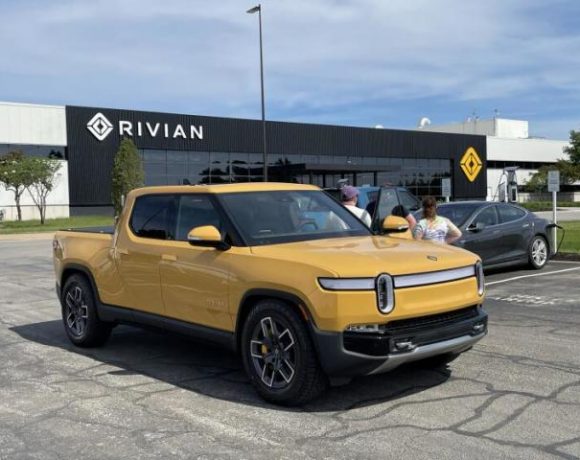
Volkswagen (VW), the German automotive giant, has announced an investment of up to $5 billion (£3.94 billion) in Rivian, a competitor to Tesla. This partnership forms a joint venture allowing both VW and the US-based electric vehicle (EV) manufacturer to share technology. Following the announcement, Rivian’s stock surged nearly 50%.

The collaboration comes amid increasing competition among EV manufacturers and the imposition of tariffs on Chinese imports by Western nations. VW will start with an initial $1 billion investment in Rivian, with an additional $4 billion planned by 2026.

Founded in 2009, Rivian has yet to achieve a quarterly profit, reporting a net loss of over $1.4 billion in the first quarter of 2024. VW, facing pressure from competitors like Tesla and China’s BYD, is working to transition from fossil fuel-powered vehicles to EVs.

The partnership provides VW with immediate access to Rivian’s software, which it can integrate into its vehicles. The deal also comes as Chinese EV manufacturers expand globally, increasing competition. The European Union (EU) recently announced plans to raise tariffs on Chinese EV imports by up to 38%, following an investigation that found Chinese EV companies had been unfairly subsidized. China criticized these tariffs as violating international trade rules and labeled the investigation as protectionist.

The tariff increase by the EU follows the United States’ decision to raise import duties on Chinese EVs from 25% to 100%. Canada is also considering similar measures to align with its allies.

Separately, Tesla announced a recall of over 11,000 Cybertrucks sold in the US due to issues with windscreen wipers and exterior trim. The Cybertrucks were first released at the end of November last year.

Picture Courtesy: Google/images are subject to copyright