
featured News Trending

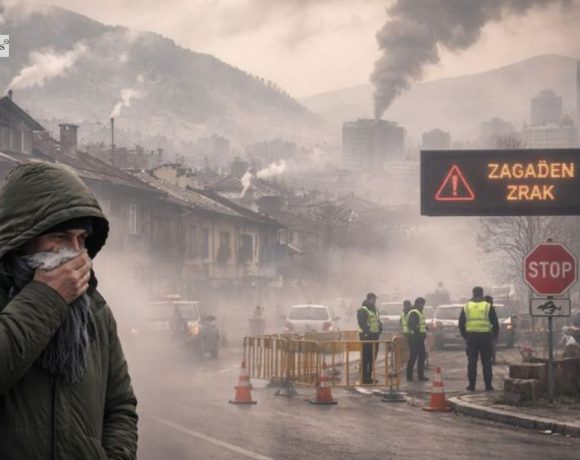
Sarajevo authorities issued an air quality warning and introduced emergency restrictions after the Bosnian capital was ranked the world’s most polluted city on two consecutive evenings by Swiss air quality monitor IQAir. The move came as hazardous air conditions gripped the city of around 350,000 people, following days of dense fog and smog. Officials said pollution levels had risen sharply, prompting immediate intervention to protect public health.

The cantonal government banned trucks weighing over 3.5 tonnes and vehicles that fail to meet European Union emissions standards from entering the city, while also suspending construction work in open areas and prohibiting outdoor public gatherings. Experts say pollution in Sarajevo is largely driven by winter heating, with around 40,000 households relying on firewood and coal, as well as heavy traffic, with nearly 180,000 registered vehicles in the city.

Sarajevo’s location in a valley surrounded by mountains worsens the problem due to temperature inversion, which traps cold air and pollutants near the ground for days. Bosnia ranks among Europe’s worst countries for fine particulate matter (PM2.5) pollution, which the World Bank links to thousands of premature deaths annually and significant economic losses. Health experts warn that prolonged exposure increases the risk of lung cancer and poses serious dangers to vulnerable groups, including children, pregnant women and the elderly.

Pic courtesy: google/ images are subject to copyright
News Trending

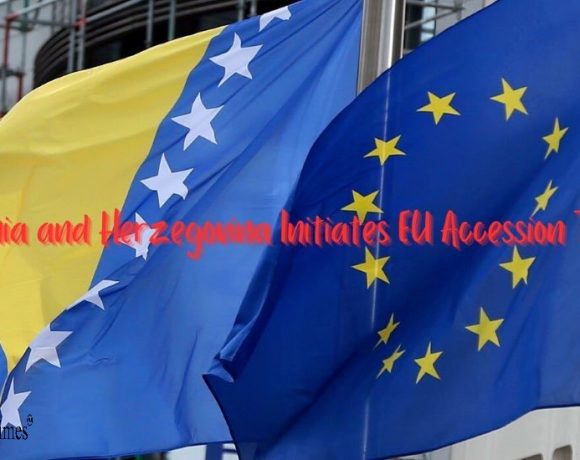
Bosnia and Herzegovina is set to begin negotiations for EU membership, marking a significant milestone eight years after the formal application was submitted. Following a recommendation from the European Commission last week, EU leaders have approved the initiation of talks. European Council President Charles Michel extended congratulations to Bosnia and Herzegovina’s leaders, affirming their place within the European family. He emphasized the importance of continued efforts for progress, a sentiment echoed by Borjana Krišto, Chairwoman of the Council of Ministers of Bosnia and Herzegovina, who expressed gratitude for achieving the necessary compliance with EU requirements.

The approval for Bosnia’s EU talks has been welcomed as a positive development by leaders across Europe. German Chancellor Olaf Scholz hailed it as a good message for the entire region, while Croatia’s Prime Minister Andrej Plenković described it as a historic day for Bosnia and Herzegovina.

The road to EU membership has been long for Bosnia, with the country formally obtaining candidate status in 2022 after applying for membership in 2016. In the past year, Bosnia has made strides in passing laws aligned with EU priorities, particularly focusing on areas such as democracy, the rule of law, fundamental rights, and public administration reform.

Despite progress, Bosnia remains ethnically and politically divided, a legacy of the 1992-95 war. Further economic and democratic reforms will be necessary before formal EU accession can occur.

The EU’s commitment to the Western Balkans has been underscored by recent events, particularly in light of the conflict in Ukraine. Other countries in the region, including Albania, Georgia, Kosovo, Moldova, Montenegro, North Macedonia, Serbia, Turkey, and Ukraine, are also at various stages of the EU application process.

Picture Courtesy: Google/images are subject to copyright