featured News Trending

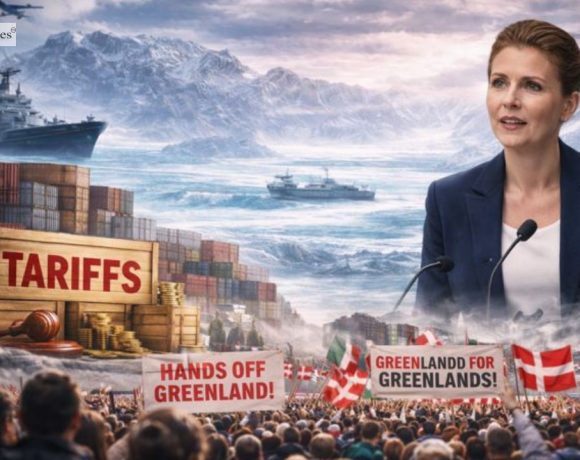
Denmark’s Prime Minister Mette Frederiksen declared that “Europe won’t be blackmailed” in response to U.S. President Donald Trump’s threat of tariffs over Greenland. Trump warned that eight U.S. allies—including Denmark, Norway, Sweden, France, Germany, the Netherlands, Finland, and the U.K.—would face new taxes starting February 1 if they opposed his proposed acquisition of the autonomous Danish territory. European leaders emphasized the importance of sovereignty and territorial integrity, issuing joint statements in solidarity with Denmark and Greenland.

Trump has justified his actions by citing Greenland’s strategic significance for U.S. security, and he has not ruled out acquiring it “the easy way” or “the hard way.” The threatened tariffs start at 10% and could increase to 25% until a deal is reached. European nations and NATO members, including the U.K., France, and Germany, condemned the coercive approach, stressing that the Arctic’s security is a shared transatlantic interest and that dialogue should be based on respect for sovereignty.

Public opposition in Denmark and Greenland has been strong, with protests calling for Greenland’s right to self-determination. Polls indicate that both Greenlanders and Americans largely oppose U.S. control of the island. European leaders, including French President Emmanuel Macron and German officials, are coordinating their responses and preparing contingency measures, including invoking EU anti-coercion instruments if the tariffs are implemented.

Pic courtesy: google/ images are subject to copyright
featured News Trending

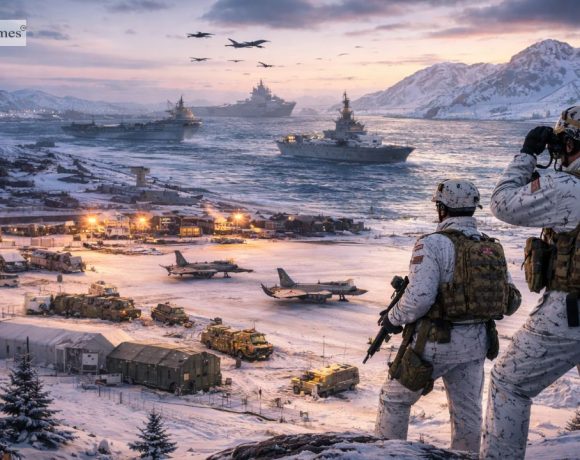
Nordic diplomats have rejected U.S. President Donald Trump’s claims that Russian and Chinese vessels are operating near Greenland, calling the assertions unfounded. According to a report by the Financial Times, two senior Nordic diplomats with access to NATO intelligence briefings said there have been no signs of Russian or Chinese ships or submarines in waters around Greenland in recent years. Reuters said it could not independently verify the report, while the White House and NATO did not immediately respond to requests for comment.

Diplomats cited by the FT said intelligence assessments do not support the narrative of heightened foreign naval activity near the island. One senior official was quoted as saying there were “no ships, no submarines,” while another dismissed claims that the waters around Greenland were “crawling” with Russian and Chinese vessels, noting that any such activity was instead concentrated on the Russian side of the Arctic. Vessel-tracking data from MarineTraffic and LSEG also showed no Chinese or Russian ship presence near Greenland.

Trump has repeatedly argued that the United States must control Greenland—an autonomous territory within the Kingdom of Denmark—to prevent Russia or China from gaining a foothold in the strategically located and resource-rich region. Denmark has disputed these claims, with Foreign Minister Lars Løkke Rasmussen saying the portrayal of foreign ships and large Chinese investments near Nuuk was inaccurate. Greenland’s assembly has since moved up a meeting to discuss its response to U.S. statements, amid growing concern among the island’s 57,000 residents over renewed pressure from Washington.

Pic courtesy: google/ images are subject to copyright
featured News Trending

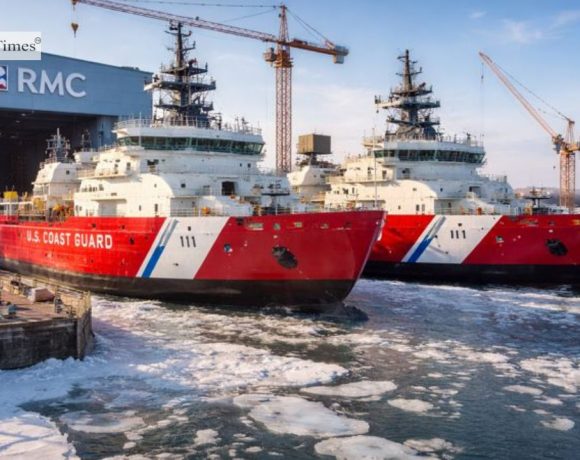
Finland’s Rauma Marine Constructions (RMC) has signed an agreement to build two icebreaker ships for the United States Coast Guard, with delivery scheduled for 2028. The deal comes as the US looks to strengthen its national security presence in the Arctic, where strategic competition has been intensifying. The vessels will be built at Finnish shipyards, known globally for their expertise in ice-capable ships.

These icebreakers are the first to be developed under a memorandum of understanding signed in October by US President Donald Trump and Finnish President Alexander Stubb. Under the agreement, Finland will construct four medium-sized Arctic Security Cutters, while the US plans to build up to seven additional vessels domestically, using Finnish technology and know-how. While RMC did not disclose the value of the two-ship contract, US officials estimate the total cost of procuring 11 icebreakers at around $6.1 billion.

RMC CEO Mika Nieminen described the deal as a historic milestone, highlighting the company’s ability to deliver vessels quickly and cost-effectively. The move addresses a growing capability gap, as the US Coast Guard currently operates just two polar icebreakers compared to Russia’s fleet of around 40. Finnish officials welcomed the agreement, calling it a major boost for Finland’s maritime industry and a recognition of the country’s leadership in icebreaker construction.

Pic courtesy: google/ images are subject to copyright