It’s difficult to avoid feeling a little overawed by the Toulouse Airbus facility.
It is a sizable facility where 28,000 employees work alongside hundreds of visitors who are anxious to watch the planes being constructed.
The massive Beluga freight jet is waiting to fly cars and satellites all over the world as it sits stationed at a loading dock.
The hangar where the Concorde supersonic passenger plane was created is not far from where we do our interviews.
A lot of Airbus research and development is being conducted at this location, including the recently completed Project Dragonfly, an attempt to increase the capabilities of the autopilot.
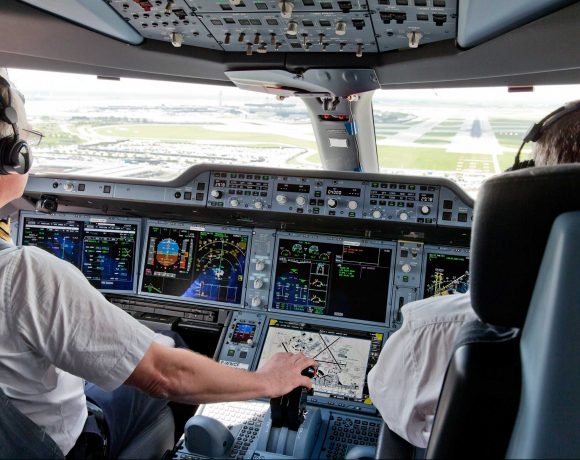
The function of the pilot has changed significantly during the past 50 years due to aviation technology. Today’s pilots benefit greatly from the technology in the cockpit.
On an Airbus A350-1000, Project Dragonfly significantly increased the autonomy of the aircraft.
Improved autonomous landing, taxi assistance, and automated emergency diversion were the three areas on which the project concentrated.
The concept is that if the pilots need to concentrate on making important decisions or if they were to become disabled, this technology would take over.
The aeroplane can descend and land on its own while identifying other aircraft, the environment, and the terrain.
The technology also enables the employment of a synthetic voice produced by artificial intelligence for radio communication between the aircraft and air traffic control.
It is a lot for the systems of the aircraft to handle.
Two emergency descents by Project Dragonfly went well.
The aircraft landed successfully on the test flights since French air traffic controllers were well aware of the circumstances.
“It was really an amazing feat,” recalls Mr. Mendes.
Project Dragonfly investigated the use of several sensors to assist an automatic landing by an aeroplane.
It included combining the use of radar, infrared, and standard cameras.
In order to mimic various meteorological situations, the researchers collected gathered data from around the globe.
What do pilots think of these changes? Some people oppose pushing technology too far.
Tony Lucas, president of the Australian and International Pilots Association, said: “I don’t know if any pilot is particularly comfortable with the computer being the sole arbiter of whether or not a flight successfully lands.”
From his base at Sydney Airport, he said, “Two well-trained and rested pilots on the flight deck cannot be replaced by automation in the decision-making process.
Mr. Lucas cited the Boeing 737 Max as an example, in which an automated system resulted in two catastrophic disasters in 2018 and 2019.
Airbus is keen to stress out that more automation won’t be implemented until it is safe to do so and that keeping pilots in the cockpit is not the goal.
However, is it possible that someday, no pilots will be required for passenger plans?
According to Mr. Ridley, fully autonomous aircraft would only ever fly if doing so was unquestionably and safely the best option for protecting our passengers and crew.
Picture Courtesy: Google/images are subject to copyright