
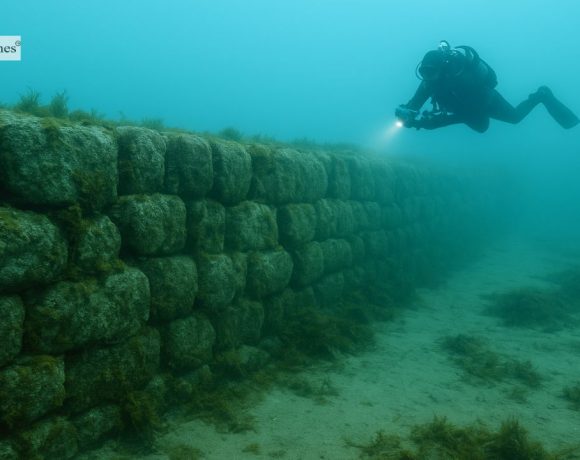
French marine archaeologists have uncovered a massive 120-metre-long undersea wall off Brittany’s Ile de Sein, dating back to around 5,000 BC. Believed to be the largest underwater structure ever found in France, the wall now lies nine metres below the surface but would once have stood on the shoreline, built by a highly organised Stone Age community. Researchers suggest it may have served as a fish trap or a protective barrier against rising sea levels.
The wall, measuring 20 metres wide and two metres high, includes rows of granite monoliths that were originally placed on bedrock before the rest of the structure was built around them. These monoliths may have supported wooden nets to catch fish during receding tides. With an estimated mass of 3,300 tonnes, the construction points to a settled society with sophisticated engineering knowledge, possibly bridging the skills of Mesolithic hunter-gatherers and later Neolithic settlers.
The discovery was first made after a geologist noticed an unusual formation on modern undersea charts, prompting diving expeditions in 2022 and detailed mapping the following winter. Archaeologists propose that such submerged structures could be connected to Breton legends of sunken cities, such as the mythical city of Ys. They believe rapid sea-level rise and the subsequent abandonment of coastal settlements may have left a deep imprint on cultural memory.
Pic courtesy: google/ images are subject to copyright